
Marketing Your Small Business: The Power of Search Engine Marketing

Search Engine Marketing for Small Business
Why Search Engine Marketing Matters for Small Businesses
Search engine marketing for small business combines paid advertising and organic optimization to help you appear when potential customers are actively searching for your services.
The difference between marketing that feels busy and marketing that actually drives leads is intent. Search engines capture intent in real time. When someone searches "water heater repair," "immigration lawyer near me," or "roof leak emergency," they are usually not looking for ideas, they are looking for a provider.
For small, service-based businesses across the Rio Grande Valley (and other competitive metros like Austin, San Antonio, Houston, Dallas, and Miami), this matters because it creates a predictable way to generate:
- Phone calls
- Quote requests
- Booking form submissions
- Direction requests and Google Business Profile actions
Quick Answer: What is Search Engine Marketing?
- Paid Search (PPC): Run ads on Google and Bing that appear at the top of search results, you only pay when someone clicks
- Organic SEO: Optimize your website to rank naturally in search results over time
- Local Targeting: Show your ads to customers in specific cities, ZIP codes, or within a radius of your location
- Immediate + Long-Term: PPC delivers leads today while SEO builds lasting visibility
- Measurable Results: Track exactly how many calls, form fills, and customers came from your campaigns
If you're a contractor in McAllen tired of waiting for the phone to ring, or a lawyer frustrated that competitors rank above you on Google, SEM puts you in front of ready-to-buy customers right now, while also building your brand for the future.
Unlike traditional advertising where you pay whether it works or not, search engine marketing charges you only when someone clicks your ad. According to industry research, 46% of all Google searches have local intent, and businesses with optimized profiles are 70% more likely to receive location visits.
The best part? You don't need a Fortune 500 budget. Small businesses in competitive industries like home services, legal, and construction can start with $500 to $2,000 per month and see real leads within days of launching.
To make SEM work, you need more than "turn ads on." You need the full click-to-customer path to be intentional:
- The keyword and the ad: Match what the customer is urgently trying to solve
- The landing page: Load fast, answer questions clearly, and make it easy to call or request a quote
- Conversion tracking: Measure calls, forms, and booked jobs, not just clicks
- Follow-up: Respond quickly so you win the lead before a competitor does
I'm Angela D., an SEO Account Manager who has helped small businesses improve their rankings and drive measurable growth through effective search engine marketing for small business strategies.
Strategic Search Engine Marketing for Small Business
At its heart, search engine marketing for small business is about visibility. When someone in the Rio Grande Valley types "emergency plumber" or "divorce lawyer near me" into Google, they aren't just browsing; they have a specific problem that needs an immediate solution.
The Core Components of SEM
Paid Search Advertising (PPC) • Immediate Results: Your ads can go live and start generating traffic in less than 24 hours. • Budget Control: You set a daily limit (e.g., $20/day) to test specific markets. • Precision Targeting: Bid on high-intent keywords like "buy" or "get quote" to avoid wasting money. • Learn more: Pay-per-click (PPC) advertising
Search Engine Optimization (SEO) • Compounding Value: SEO is an investment that builds authority over time, even after you stop active spending. • Trust and Credibility: Ranking in organic results tells customers you are an established local authority. • Cost-Efficiency: Over the long run, the cost per lead from organic search is often significantly lower than paid ads. • Deep Dive: que-es-seo-maximizando-visibilidad-online
Essential Steps to Launch Your Strategy
- Keyword Research: Use tools like Google Keyword Planner to find specific local terms (e.g., "personal injury lawyer in Brownsville").
- Analyze Search Intent: Focus your paid budget on transactional intent (e.g., "plumbing repair") rather than informational queries.
- Competitor Analysis: See what ads your competitors are running and offer something more unique.
- Set Your Budget: Decide on a monthly "test" budget based on your specific market competition.
- Get Guided: If you're new, start with a beginner-guide-small-business-ads.
The Mechanics of Paid Search: PPC, Auctions, and Bidding
How does Google decide whose ad shows up at the very top? It’s a lightning-fast auction that happens every single time a search is performed.
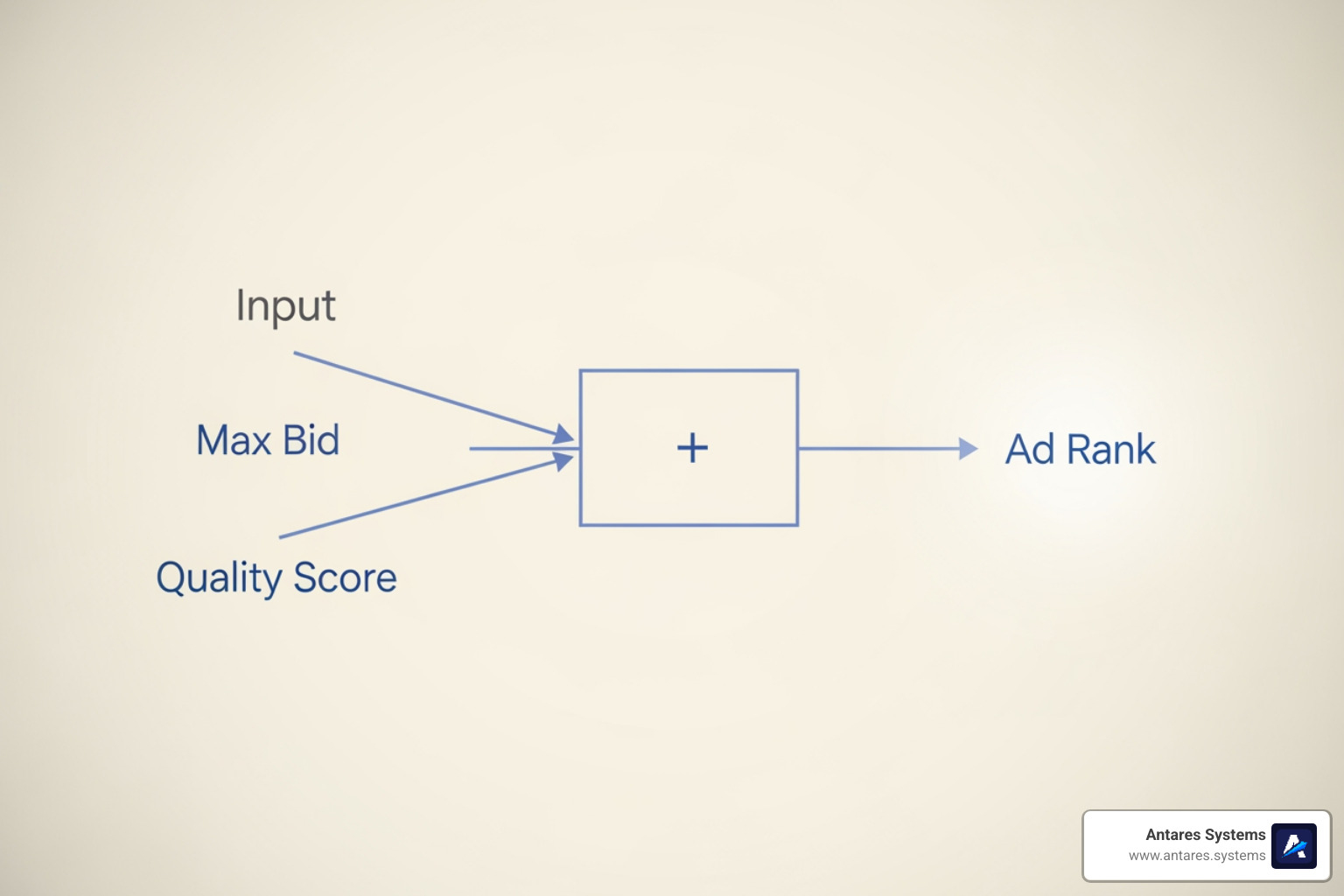
How the Ad Auction Works
Google uses a system called Ad Rank(Bid x Quality Score) to determine your position.
• The Bid: The maximum amount you’re willing to pay for a single click. • Quality Score: Google's measure of helpfulness, including:
- Ad Relevance: Does your ad match the search query?
- Expected Click-Through Rate (CTR): How likely is someone to click?
- Landing Page Experience: Is your website fast and mobile-friendly?
Budget Management
• Daily Caps: Set a daily budget (e.g., $30/day) to ensure there are never any surprise bills. • Negative Keywords: Tell Google not to show your ad for certain words (e.g., "cheap" or "free") to filter out low-quality leads.
Hyper-Local Targeting: Winning the "Near Me" Search
For service-based businesses, "near me" searches are the holy grail. Nearly half of your potential customers are looking for someone in their immediate vicinity.
Tactics for Local Dominance
Radius Targeting • Set a specific radius (e.g., 10 miles) around your office to ensure your budget is only spent on local customers.
Location Extensions • Add-ons that show your physical address, a "call" button, and distance from the user to increase click-through rates.
Geo-Specific Keywords • Bid on terms like "roofing contractor in McAllen" to capture users who have already decided they want someone local.
Local Landing Pages • Ensure ad clicks lead to pages that mention the specific city and show local testimonials. This is a core part of Google Business Profile optimization.
Best Practices for High-Converting Ad Campaigns
Getting the click is only half the battle. You need that click to turn into a phone call or a lead form.
Crafting Compelling Ads
• Headline Strategy: Include your main keyword and a "hook" (e.g., "Free Estimates" or "24/7 Emergency Service"). • Description Lines: Solve a problem immediately (e.g., "Stop the leak before it ruins your floors"). • Ad Extensions: Use Sitelinks for specific pages and Callouts for perks like "Licensed & Insured."
Optimizing ROI
• Conversion Rate: Track the percentage of people who take action after clicking. • ROAS (Return on Ad Spend): Measure your profit against your ad spend (e.g., $500 spend for a $5,000 project is a 10x ROAS). • Google Analytics: Monitor "bounce rates" to see if your landing page needs technical improvements. Refer to tracking conversions in Google Analytics.
The Impact of AI on Modern SEM Strategies
The world of search is changing. With the rise of Generative AI, Google is now providing "AI Overviews" at the top of the page.
Adapting to the AI Era
• Generative Engine Optimization (GEO): Structure your content so AI models like Google Gemini can easily cite your business as an authority. • Answer Engine Optimization (AEO): Provide clear, concise answers (50-60 words) to common customer questions. • Conversational Search: Target "long-tail" keywords that mimic how people speak to voice assistants. • AI-Powered Bidding: Use automated systems to adjust bids in real-time for maximum efficiency during peak hours.
Frequently Asked Questions about SEM
How long does it take to see results from SEM?
• Paid Search: Results are nearly immediate. Ads can start appearing and generating leads within hours of approval. • Organic SEO: This is a long-term strategy; expect to wait 6-12 months for significant movement in rankings.
How much should a small business budget for SEM?
• Recommended Start: $500 to $2,000 per month for most local service businesses. • Competitive Markets: High-stakes industries like law in major cities (Houston/Dallas) may require higher investment.
Can I manage SEM on my own?
• The Risk: While possible, DIY management often leads to paying for "junk" clicks due to incorrect match types or missing negative keywords. • The Benefit of Pros: An agency ensures your budget is treated as an investment with measurable returns.
Conclusion
Search engine marketing for small business is the most powerful tool in your digital arsenal. It levels the playing field, allowing local contractors to stand toe-to-toe with national franchises.
Summary of Success
• Immediate Visibility: Get in front of customers the moment they need you. • Hyper-Local Focus: Don't waste money on clicks from outside your service area. • Data-Driven Growth: Use AI and analytics to constantly improve your ROI.
At Antares Systems, we specialize in helping small, service-based businesses dominate their local markets. From AI-powered website design to expert local-seo-services, we handle the technical heavy lifting.
Ready to grow your business? Contact us today to discover how our Local SEO and SEM services can elevate your brand and drive measurable results!