Unlocking Growth: The Synergy of SEO and SEM in Your Strategy
Why Understanding Marketing SEO SEM is Critical for Your Business Growth
Marketing SEO SEM is the foundation of how customers find your business online. If you're confused about what these terms mean or how they work together, you're not alone—but understanding them can be the difference between being invisible or dominating your local market.
Quick Answer: What is Marketing SEO SEM?
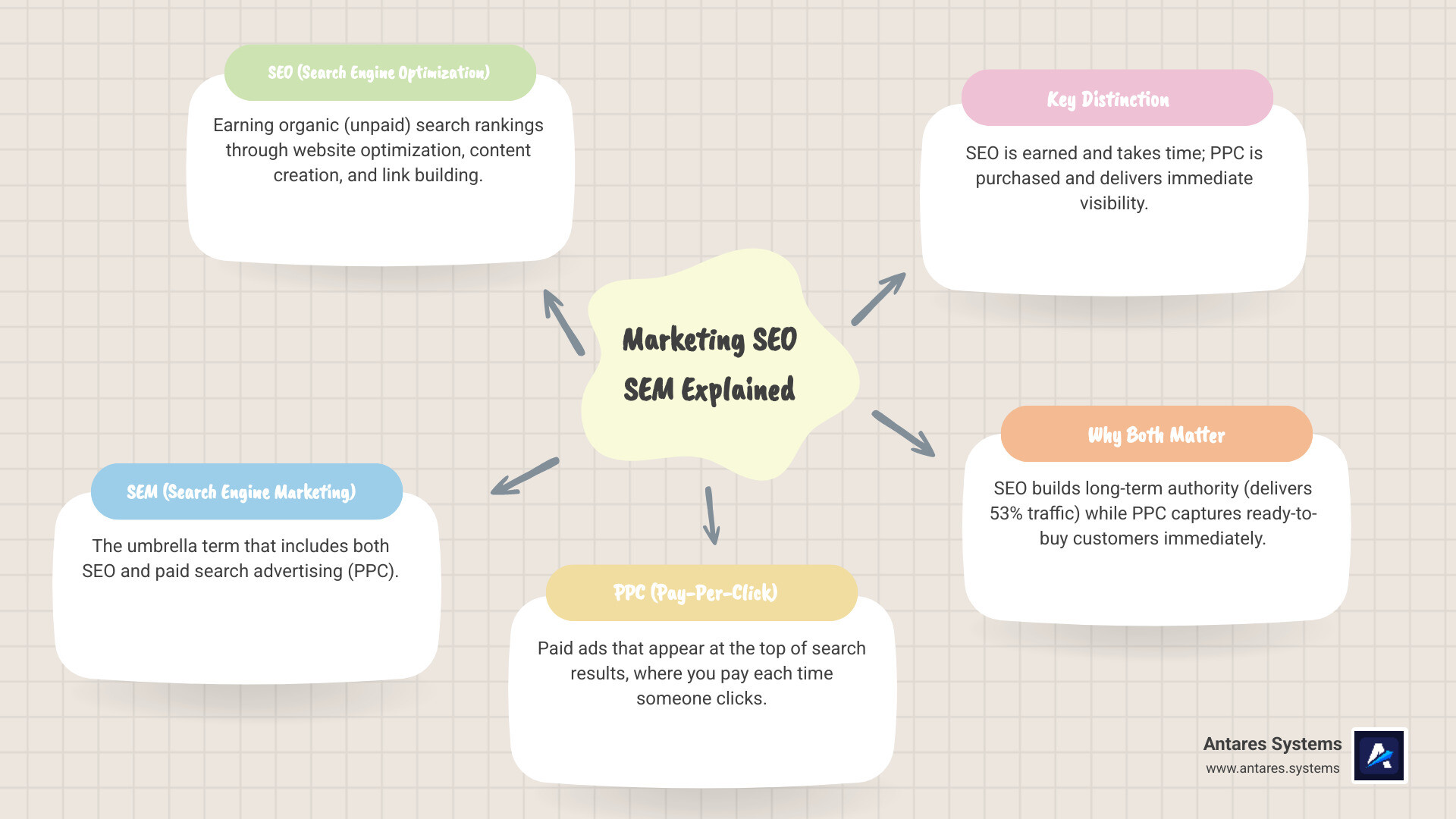
- SEO (Search Engine Optimization) – Earning organic (unpaid) search rankings through website optimization, content creation, and link building
- SEM (Search Engine Marketing) – The umbrella term that includes both SEO and paid search advertising (PPC)
- PPC (Pay-Per-Click) – Paid ads that appear at the top of search results, where you pay each time someone clicks
- The Key Difference – SEO is earned and takes time; PPC is purchased and delivers immediate visibility
- Why Both Matter – SEO builds long-term authority while PPC captures ready-to-buy customers right now
When you search for something on Google, you see two types of results: organic listings(earned through SEO) and paid ads(bought through SEM campaigns). Most business owners think they have to choose between them. That's a costly mistake.
The truth is simple: SEO and SEM work best together. SEO builds a sustainable foundation that keeps bringing in customers month after month—without paying for every click. SEM gives you instant visibility for high-value keywords while your SEO efforts gain momentum.
Here's what makes this powerful: organic search delivers 53% of all website traffic, and users click organic results over ads 94% of the time. But paid ads still dominate the top of the page, and they start working immediately. When you combine both strategies, you don't just show up in search results—you own the entire first page.
This isn't theory. More than 8.5 billion searches happen every day on Google, and your competitors are fighting for every single one. If you're only doing SEO, you're leaving immediate sales on the table. If you're only running ads, you're paying for traffic you could be earning for free.
The businesses that win are the ones that understand how these strategies complement each other. They use PPC data to find converting keywords for their SEO strategy. They use organic content to lower their ad costs and improve Quality Scores. They show up everywhere their customers are searching—and they do it without wasting money.
This guide will show you exactly how marketing SEO SEM strategies work, when to use each one, and how to integrate them for maximum growth. You'll learn the core differences between SEO and SEM, find how to build a unified strategy, and understand what's coming next as AI reshapes search.
I'm Angela D., an SEO Account Manager who has helped businesses double their organic traffic and build profitable PPC campaigns by integrating marketing SEO SEM strategies that deliver measurable results. I've seen how the right combination of earned and paid search can transform a struggling online presence into a lead-generating machine.
Let's break down how search marketing really works—and how you can use it to grow your business.
What is SEO? The Foundation for Long-Term Organic Growth
At its core, Search Engine Optimization (SEO) is the art and science of improving your website's visibility when people search for products or services related to your business on search engines like Google. It’s about making your website appealing to search engines so they choose to display your content prominently in their organic (unpaid) results.
Search Engine Optimization (SEO)
Think of search engines as incredibly sophisticated librarians. When you search for information, the librarian (Google, in this case, which handles 91% of the global search engine market) doesn't just guess. It uses automated programs called "crawlers" to constantly explore the web, reading and understanding billions of web pages. These pages are then added to a massive "index" – a giant catalog of all the content it knows about. Finally, when you type a query, the search engine ranks the relevant pages based on hundreds of factors to provide the best possible answer. This process is called crawling, indexing, and ranking.
Our goal with SEO is to help these digital librarians find, understand, and trust our content so they recommend it to users. This involves several key areas:
- On-page SEO: This refers to all the optimizations we make directly on our website pages. This includes crafting compelling content, using relevant keywords in titles, headings, and body text, optimizing images, and ensuring our website provides a great user experience. If you’re looking to dive deeper, we have more info about on-page SEO that can guide you.
- Off-page SEO: These are actions taken outside of our website to impact our rankings. The most common and impactful off-page SEO tactic is building high-quality backlinks from other reputable websites. Think of these as votes of confidence from other sites, telling search engines that our content is valuable and trustworthy.
- Technical SEO: This ensures our website's technical foundation is solid, allowing search engines to crawl and index our site efficiently. This includes site speed, mobile-friendliness, site architecture, and using structured data. Google itself provides an excellent SEO starter guide that outlines many of these fundamentals.
The benefits of a strong SEO strategy are undeniable. Organic search delivers a staggering 53% of all website traffic, and users click organic results over ads 94 percent of the time. While it takes time—an average of 2 years to rank on the first page of Google for competitive terms—the results are sustainable, building a lasting digital asset that continuously brings in high-quality traffic. For small businesses in areas like McAllen, Houston, or Austin, building a robust Local SEO presence is particularly vital for connecting with nearby customers.
What is SEM? Capturing Immediate Search Visibility
While SEO builds long-term organic presence, Search Engine Marketing (SEM) offers a more immediate path to visibility. SEM is a broader term that encompasses both SEO and paid search advertising, often referred to as Pay-Per-Click (PPC). When we talk about SEM in the context of immediate visibility, we're usually referring to those paid ads that appear prominently at the top and bottom of search engine results pages (SERPs).
Search Engine Marketing (SEM)
With PPC, we bid on keywords that users type into search engines. When someone searches for a keyword we're bidding on, our ad might appear. If a user clicks our ad, we pay a fee—this is known as the Cost Per Click (CPC). The position of our ad isn't just about how much we bid; it's also heavily influenced by our Quality Score. Google's Quality Score is a metric that assesses the relevance and quality of our ads, keywords, and landing pages. A higher Quality Score can lead to better ad positions at a lower cost.
Key components of an effective SEM (PPC) strategy include:
- Keyword Bidding: Researching and bidding on relevant keywords that our target audience is using.
- Ad Copy: Crafting compelling ad headlines and descriptions that encourage clicks.
- Landing Page Optimization: Ensuring that the page users land on after clicking our ad is highly relevant, user-friendly, and designed to convert.
- Campaign Management: Continuously monitoring, testing, and optimizing campaigns to maximize return on investment (ROI).
The primary advantage of SEM (PPC) is its speed. Unlike SEO, which can take months or even years to yield significant results, PPC campaigns can generate traffic and leads almost instantly. This makes it an invaluable tool for product launches, seasonal promotions, or when we need to quickly capture demand for our services in markets like Dallas or San Antonio. For small businesses, our beginner's guide to small business ads provides an excellent starting point.
SEO vs. SEM: A Detailed Comparison
While both SEO and SEM are crucial for online visibility, they operate on different principles and offer distinct advantages. Understanding these differences is key to crafting a balanced and effective marketing SEO SEM strategy.
Time to Results
-
SEO (Organic Search):
- This is a long-term game. While some initial movement might be seen in a few months, it typically takes 6-12 months for significant organic traffic to materialize. For highly competitive keywords, we've seen it take over a year, with some analyses suggesting an average of 2 years to rank on the first page of Google.
- Our take: Think of SEO as planting a tree. It takes time to grow, but once it's mature, it provides shade (traffic) for years to come.
-
SEM (Paid Search / PPC):
- The beauty of SEM is its immediacy. Ads can go live shortly after campaign launch, and we can start seeing traffic and conversions within hours or days.
- Our take: SEM is like buying a bouquet of flowers. Instant beauty, but it requires continuous replenishment.
Cost & Investment
-
SEO (Organic Search):
- Traffic from SEO is often called "free" because we don't pay per click. However, this is a bit misleading. There's a significant investment in content creation, technical optimizations, link building efforts, and the time of skilled professionals.
- Our take: While the clicks are "free," the expertise and effort required to earn them are a valuable investment in our digital asset.
-
SEM (Paid Search / PPC):
- This is a direct cost model. We set a budget and pay for every click our ads receive. This means ongoing advertising expenditure is necessary to maintain visibility.
- Our take: It's a direct transaction. We pay, we play. If we stop paying, the traffic stops.
Traffic Sustainability
-
SEO (Organic Search):
- Once we achieve high organic rankings, they can deliver consistent, sustainable traffic for an extended period. It builds a lasting digital asset that continues to generate value.
- Our take: SEO creates a flywheel effect. Good rankings lead to more traffic, which can lead to more engagement and potentially more links, further boosting rankings.
-
SEM (Paid Search / PPC):
- Traffic from PPC is temporary. As soon as our ad budget runs out or we pause a campaign, the traffic ceases.
- Our take: It's an on-demand service. Great for quick boosts, but not a permanent solution on its own.
Position on the SERP
-
SEO (Organic Search):
- Organic results typically appear below the paid ads. Despite this, users often perceive organic results as more credible and authoritative, leading to a higher click-through rate ( users click organic results over ads 94% of the time).
- Our take: The "earned" nature of organic results builds trust with users.
-
SEM (Paid Search / PPC):
- Paid ads occupy prime real estate at the very top and sometimes at the bottom of the SERP, clearly marked as "Ad" or "Sponsored." This guarantees immediate top-of-page visibility for targeted keywords.
- Our take: For immediate impact and guaranteed visibility, paid ads are king.
The Power of Integration: Why Your Marketing Needs Both SEO and SEM
Now that we understand the distinct roles of SEO and SEM, let's talk about the magic that happens when we combine them. Running SEO and SEM in silos is like having two powerful engines in a boat, but only running one at a time. The real speed and efficiency come from firing them both up in harmony.
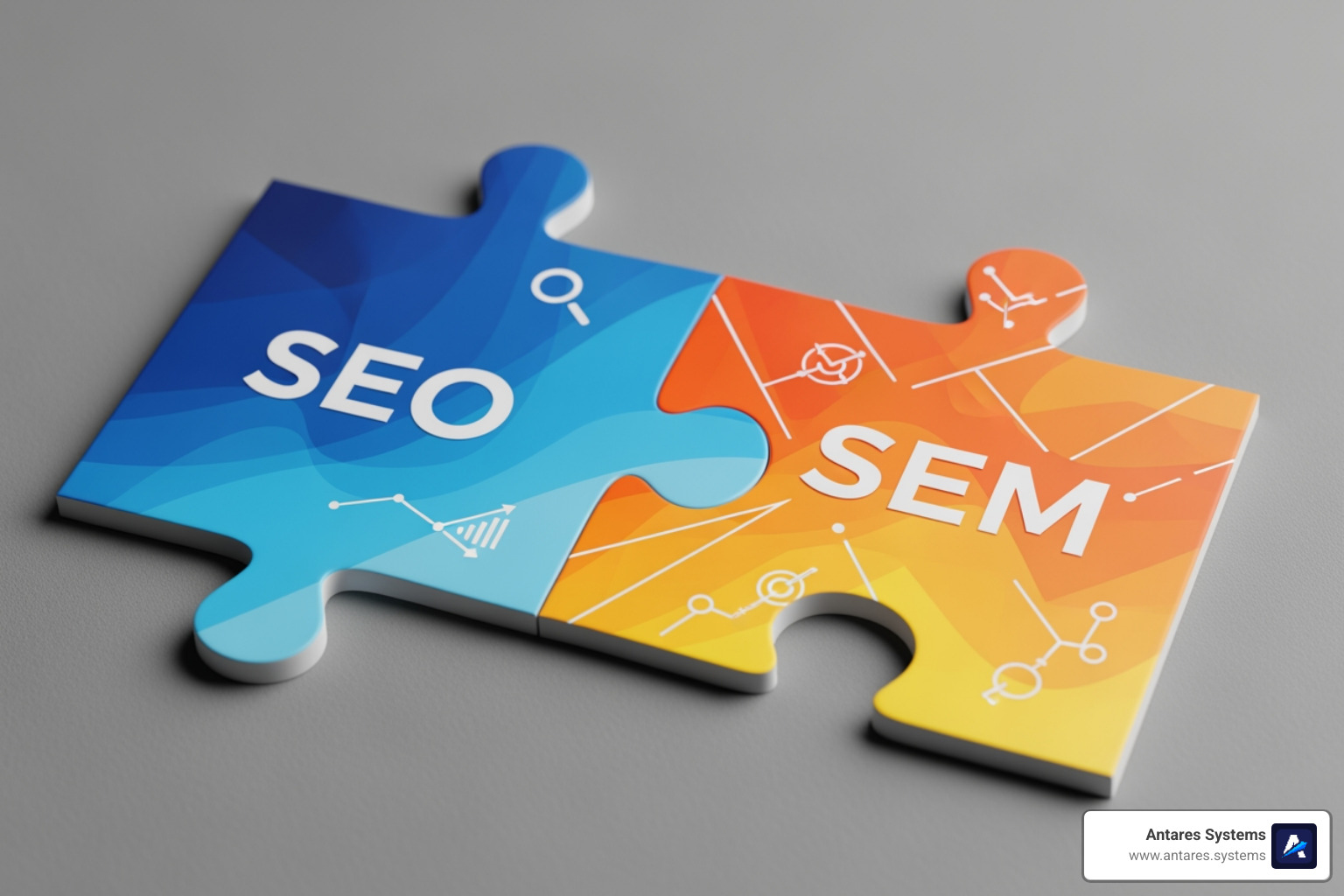
When we intelligently integrate our marketing SEO SEM efforts, we create a synergy that yields a much higher ROI than either strategy could achieve alone. Here’s why this integrated approach is a game-changer for businesses in places like Miami, Florida, or the Rio Grande Valley:
- Synergy for Higher ROI: By combining the long-term, trust-building power of SEO with the immediate, targeted reach of SEM, we maximize our overall visibility and conversions. Each strategy amplifies the other's effectiveness, leading to a better return on our marketing investment.
- SERP Domination and Increased Brand Visibility: Imagine owning not just the top ad spots but also the top organic rankings for your most important keywords. This kind of omnipresence on the search results page significantly boosts brand recognition and captures a larger share of user attention.
- Supports the Entire Customer Journey: SEO excels at capturing users in the early, research-oriented stages of their journey (top-of-funnel), where they're looking for information and solutions. SEM, particularly PPC, is highly effective at reaching users who are further down the funnel, ready to make a purchase or contact a service provider (bottom-of-funnel). By using both, we ensure we're present at every critical touchpoint. To understand this better, explore the customer journey vs sales funnel.
- Data Sharing and Keyword Insights: This is where integration gets really smart. Data from our PPC campaigns (like which keywords convert best, or which ad copy resonates) can inform and refine our SEO strategy. Conversely, successful organic keywords can be used to identify new, profitable opportunities for our paid campaigns.
- Quality Score Improvement and A/B Testing: An SEO-optimized website with relevant, high-quality content and excellent user experience can directly improve the Quality Score of our PPC ads. This can lead to lower CPCs and better ad positions. Both SEO and SEM provide ample opportunities for A/B testing, allowing us to continuously refine our messaging and landing pages for optimal performance.
- Holistic Approach: Instead of juggling multiple vendors for different aspects of digital marketing, our full-service model at Antares Systems integrates PPC management, Local SEO, CRM integration, Google Business Profile optimization, content creation, and reputation management. This ensures a cohesive strategy that benefits from shared insights and consistent messaging, driving predictable growth without the stress of managing disparate efforts.
A Practical Guide to an Integrated Marketing SEO SEM Strategy
Implementing an integrated marketing SEO SEM strategy isn't just about running both campaigns; it's about making them work together seamlessly. Here’s how we approach it:
Aligning Keyword Research
The foundation of any successful search marketing campaign is thorough keyword research. In an integrated strategy, this research serves both SEO and SEM.
- Shared Keyword Strategy: We identify a master list of keywords, categorizing them by search intent (informational, navigational, transactional) and search volume. This ensures both teams are targeting the most relevant terms.
- High-Intent, Informational, and Long-Tail Keywords:
- SEO often focuses on a broader range, including informational and long-tail keywords, to capture users earlier in their journey.
- PPC typically targets high-intent, transactional keywords to capture users ready to convert.
- Use PPC Data to Inform SEO: Our PPC campaigns are fantastic testing grounds. We can quickly see which keywords generate clicks and conversions. This data is invaluable for prioritizing which content to create or optimize for SEO. If a keyword is too expensive for PPC but has high conversion potential, we might make it a long-term SEO target.
- Use SEO Research for PPC Campaigns: Conversely, our SEO research helps uncover new, relevant keywords and content gaps that we can then test with PPC campaigns. If we see a sudden surge in organic interest for a particular topic, we can quickly launch a PPC campaign to capitalize on that immediate demand.
- For a deeper dive into finding the right keywords, check out our guide on how to build a killer keyword strategy.
Creating Cohesive Content and Landing Pages
Consistency is key in an integrated strategy. Our messaging, branding, and user experience should be seamless across organic and paid channels.
- Consistent Messaging Across Channels: Ensure our ad copy, organic meta descriptions, and website content all speak the same language and convey a unified brand message. This reinforces trust and clarity for users.
- Ad Copy and Meta Descriptions Alignment: We make sure that the promises made in our PPC ads are fulfilled by the content and user experience on our landing pages and that our organic snippets align with the broader content strategy.
- Landing Page Optimization for User Experience: A high-quality landing page is crucial for both SEO (as it impacts user experience signals) and SEM (as it directly affects Quality Score and conversion rates). Our Smart Website Design ensures that our landing pages are not only visually appealing but also fast-loading, mobile-friendly, and highly relevant to the ad or organic listing that brought the user there.
- Conversion Rate Optimization (CRO): We continuously optimize our landing pages and website content to convert visitors into leads or customers. This involves A/B testing different elements, calls to action, and layouts. Our expertise in effective website design for businesses plays a significant role here.
Implementing Unified Tracking and Reporting
To truly understand the impact of our integrated strategy, we need to track everything.
- Google Analytics and Google Search Console: These tools are indispensable. Google Analytics tracks traffic, user behavior, and conversions from both organic and paid sources. Google Search Console provides insights into our organic performance, keyword rankings, and technical SEO health.
- Goal and Conversion Tracking: We set up detailed goal and conversion tracking to measure key actions on our website, whether it's a form submission, a phone call, or a purchase.
- Attribution Modeling: Understanding which touchpoints (organic search, paid search, social media, etc.) contribute to a conversion helps us allocate our budget more effectively.
- Data-Driven Decisions: By analyzing the full user path from their first interaction to conversion, we can identify bottlenecks, optimize campaigns, and make informed decisions that drive growth for our clients in places like McAllen, Houston, or San Antonio.
Overcoming Integration Challenges
While the benefits are immense, integrating SEO and SEM isn't without its problems. However, with our full-service approach, we help our clients steer these challenges smoothly:
- Budget Allocation: Deciding how to split our marketing budget between SEO and SEM can be tricky. We use data from both channels to strategically invest where we see the highest ROI and long-term potential.
- Team Communication: Historically, SEO and PPC teams have operated in silos. Our integrated model ensures constant communication and collaboration, allowing insights to flow freely between all marketing efforts.
- Breaking Down Silos: We eliminate the "us vs. them" mentality, fostering a unified approach where everyone is working towards the same business goals.
- Maintaining Brand Voice and Consistent Messaging: With an integrated team, it's easier to ensure that our brand's voice and core messages remain consistent across all organic and paid touchpoints.
The Future of Search: AI, Automation, and What's Next
The world of search is constantly evolving, and the rise of Artificial Intelligence (AI) and automation is accelerating these changes. As a digital marketing agency specializing in AI-powered solutions, we're at the forefront of these trends, ensuring our clients are always ahead of the curve.
Here’s what we’re seeing and how we’re adapting our marketing SEO SEM strategies:
- Artificial Intelligence (AI) and AI Overviews: Google is increasingly integrating AI into its search results, with features like "AI Overviews" providing generative answers directly in the SERP. This means our content not only needs to rank but also needs to be structured in a way that AI can easily synthesize and present.
- Generative Engine Optimization (GEO): This is an emerging field focused on optimizing content specifically for AI-powered search engines and generative AI models. It goes beyond traditional keyword targeting to ensure our content is comprehensive, authoritative, and structured for AI understanding.
- PPC Automation: AI is revolutionizing PPC campaign management, enabling more precise targeting, automated bidding strategies, and dynamic ad creation. This allows us to optimize ad spend and performance with unprecedented efficiency.
- E-E-A-T (Experience, Expertise, Authoritativeness, Trustworthiness): With AI playing a larger role, Google's emphasis on E-E-A-T is more critical than ever. We focus on building our clients' online presence as credible, reliable sources of information, especially for service-based businesses in legal, home services, and construction.
- People-First Content: Google's updates consistently prioritize helpful, reliable, and people-first content. Our content creation strategies are designed to answer user questions comprehensively and provide real value, not just to stuff keywords.
- Search Fragmentation: While Google remains dominant, users are increasingly searching on other platforms. For example, 51% of women in Gen Z prefer to start a search on TikTok, and many product searches begin on Amazon. This means our marketing SEO SEM strategies must diversify to capture audiences across various platforms.
- To learn more about how we harness these advancements, explore the power of AI in digital marketing. The global SEO industry alone is forecast to reach a staggering $122.11 billion by 2028, underscoring the immense growth and importance of these evolving strategies.
Frequently Asked Questions about SEO and SEM
When should a business prioritize SEO over SEM, or vice versa?
- Prioritize SEO: If we're looking for sustainable, long-term growth and have a limited budget for immediate ad spend. SEO builds foundational authority and "free" traffic over time. It's ideal for building brand awareness and establishing expertise.
- Prioritize SEM: If we need immediate leads, are launching a new product or service, or want to test new markets quickly. SEM provides instant visibility and highly targeted traffic, allowing us to generate sales right away.
- For maximum growth: An integrated approach is always recommended. It allows us to capture both immediate demand and build long-term assets simultaneously.
How long does it take to see results from SEO?
- We typically see initial movement and keyword ranking improvements within a few months.
- For significant organic traffic increases and noticeable impact on business, it usually takes 6-12 months.
- For highly competitive terms or brand new websites, it can take over a year —with some sources indicating an average of 2 years to rank on the first page of Google. Patience and consistency are key!
Is SEO or SEM better for a small business?
- Both are vital, and neither is inherently "better"; they serve different, complementary purposes.
- Local SEO is often the most cost-efficient foundation for small businesses, especially in our service areas like McAllen, Houston, or Miami. It helps us appear in local map packs and organic results when nearby customers search for our services. Our Local SEO services are designed specifically for this.
- Targeted SEM campaigns can generate immediate leads for specific services or promotions, like a plumbing service needing urgent calls or a lawyer seeking new clients. This provides quick wins while SEO builds momentum.
- Combining both provides a powerful growth strategy, allowing a small business to dominate local search, attract immediate customers, and build long-term online authority.
Conclusion
SEO and SEM are not competitors—they are partners in a comprehensive search marketing strategy. By defining their roles and integrating their strengths, you can dominate the SERPs, engage customers at every stage, and achieve a higher return on your marketing investment. At Antares Systems, we build powerful, AI-driven strategies that harness the synergy of SEO and SEM to help businesses achieve predictable growth. We understand the unique challenges and opportunities for service-based businesses in home services, legal, and construction across Texas and Florida.
Ready to open up your business's full potential on search engines? Explore our Local SEO Services and let's build a winning strategy together.