
SEM Unpacked: A Beginner's Journey into Digital Advertising
Why Search Engine Marketing Matters for Your Business
Search engine marketing is the use of paid advertising to make your business visible on search engine results pages (SERPs) like Google and Bing. Here's a quick overview:
What SEM Does:
- Places your ads at the top of search results for relevant customer queries.
- Works on a pay-per-click model-you only pay when someone clicks your ad.
- Delivers immediate visibility and traffic to your website.
- Targets customers actively searching for what you offer right now.
Core Components:
- Keyword Research- Finding the terms your customers use to search.
- Ad Creation- Writing compelling ads that get clicks.
- Bidding Strategy- Deciding how much you'll pay per click.
- Landing Pages- Directing clicks to pages designed to convert visitors.
How It Differs from SEO:
- SEM is paid advertising for instant results.
- SEO is organic optimization that builds traffic over time.
- Both work together for maximum online visibility.
If you're a plumber or lawyer in the Rio Grande Valley, SEM puts you at the top when someone searches "emergency plumber near me" or "personal injury lawyer McAllen."
The numbers tell the story: 91% of online adults use search engines to find information, and a significant portion of ad spending goes to search ads. However, many small businesses waste money on campaigns that don't convert due to a lack of strategy.
I'm Angela D., an SEO Account Manager who has helped dozens of businesses in home services, legal, and construction drive measurable growth with effective search engine marketing. I've seen how the right SEM strategy can transform a business into one with a full calendar of booked jobs.
The Two Sides of Search: SEM vs. SEO
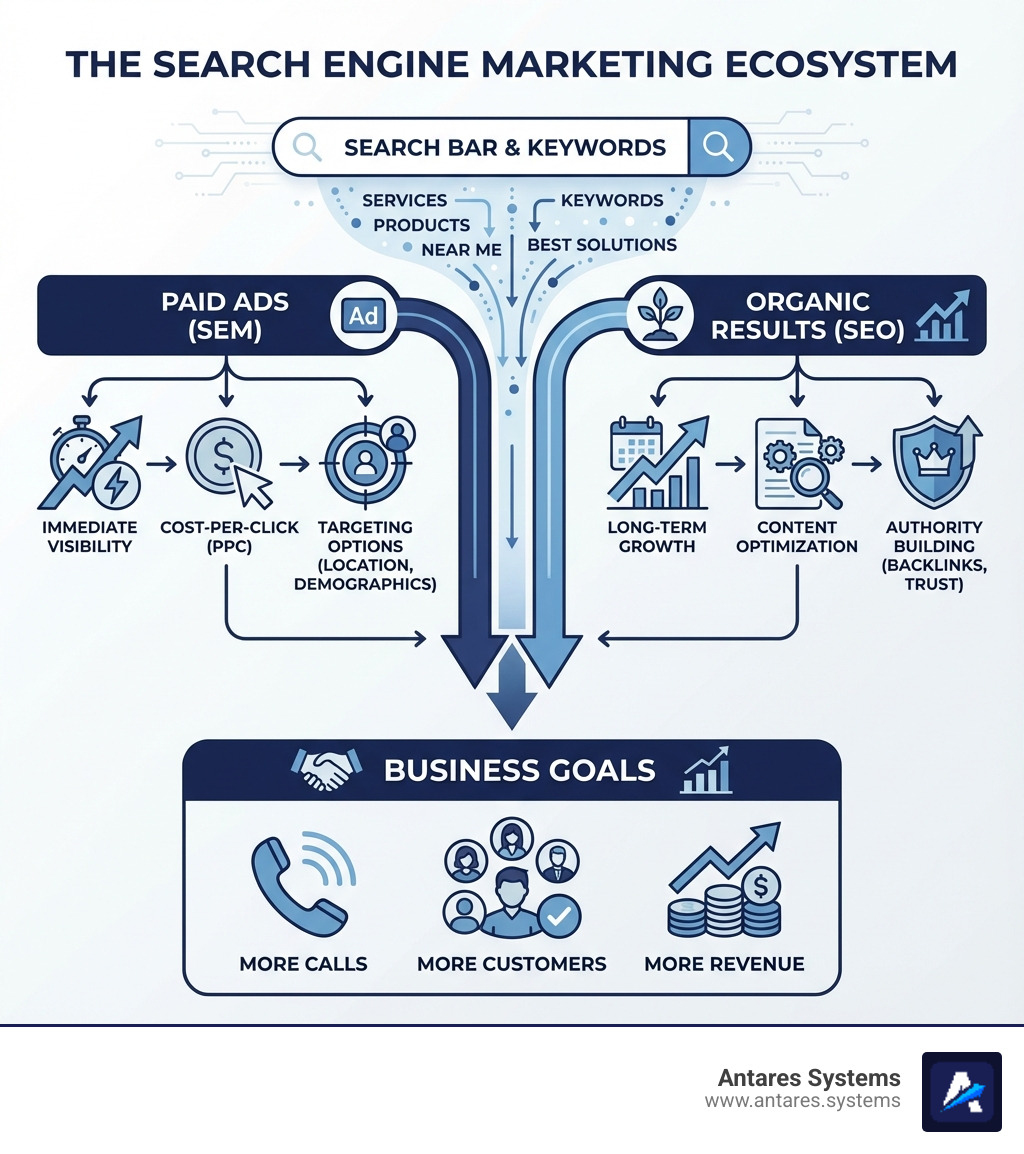
It's crucial to understand the relationship between search engine marketing(SEM) and Search Engine Optimization (SEO). While both aim to increase visibility on search engine results pages (SERPs), they use different methods. Today, SEM refers almost exclusively to paid search advertising (Pay-Per-Click or PPC), while SEO focuses on organic, unpaid results.
Let's break down the key differences:
Search Engine Marketing (SEM)
- Paid Visibility: We pay search engines like Google Ads to display our ads on SERPs.
- Immediate Results: Once launched, ads can appear almost instantly, driving immediate traffic. This is ideal for quick campaigns or new product launches.
- Bottom-of-Funnel Focus: SEM excels at capturing users with high commercial intent-those ready to buy right now. A search for "emergency plumbing repair McAllen" is a perfect example.
- Direct Control: We have direct control over ad copy, bidding, targeting, and budget, allowing for easy adjustments based on performance.
Search Engine Optimization (SEO)
- Organic Visibility: We earn visibility by optimizing our website's content, structure, and authority to rank naturally.
- Long-Term Strategy: SEO is a marathon. It takes time to build authority and rankings, but the results are often more sustainable and cost-effective long-term.
- Top-to-Mid Funnel Focus: SEO attracts users at all stages of the buyer's journey, from information seekers ("how to fix a leaky faucet") to those comparing options.
- Indirect Control: We influence rankings through best practices, but search engine algorithms have the final say on our position.
Complementary Strategies
SEM and SEO are not mutually exclusive; they are powerful when used together. SEO builds the foundation and long-term authority, while SEM acts as an accelerator, driving immediate, targeted traffic.
While the top organic result on Google gets significantly more clicks, SEM still captures attention for high-intent queries. By running both, we can:
- Maximize SERP Real Estate: Dominate both paid and organic sections of the results page.
- Gather Data: Use SEM campaign data to inform and improve our SEO strategy.
- Test Keywords: Quickly test new keywords with SEM before investing in long-term SEO content.
- Fill Gaps: Appear for keywords where our organic ranking isn't strong yet.
Understanding the synergy between these two components is key to a comprehensive strategy that drives business growth. If you want to dive deeper, we have a helpful guide on the topic: Diferencia entre SEO y SEM.
The Engine Room: Core Components of an Effective Search Engine Marketing Strategy
A successful search engine marketing strategy is about more than spending money on ads; it requires a carefully planned and executed approach. An effective SEM campaign includes deep keyword research, precise ad targeting, smart bidding, and a well-structured account.

Understanding Keywords in search engine marketing
Keywords are the cornerstone of search engine marketing. They are the words potential customers type into search engines. Our goal is to identify these keywords and bid on them so our ads appear.
-
User Intent: Understanding the intent behind a search is crucial. Are users looking to buy, or are they just gathering information? This distinction guides your bidding strategy.
- Transactional Keywords: These indicate a user is ready to buy (e.g., "buy plumbing services McAllen"). They often have higher competition and cost-per-click (CPC) but yield higher conversion rates.
- Informational Keywords: These show a user is seeking information (e.g., "how to fix a clogged drain"). They are less suitable for direct SEM conversions but great for SEO.
-
Keyword Volume and Competition: We analyze how many people search for a keyword (volume) and how many advertisers bid on it (competition). The goal is to balance high-intent terms with more niche, long-tail keywords.
-
Negative Keywords: Just as important as choosing the right keywords is excluding the wrong ones. Negative keywords prevent ads from showing for irrelevant searches, saving your budget. For instance, a new home builder would add "rental" as a negative keyword.
When starting with SEM, especially with a small budget, focus only on transactional keywords important to your business. This is especially true for our clients in Dallas, Houston, and Miami, where budget efficiency is paramount. For more insights, check out our Guía para principiantes de anuncios para pequeñas empresas.
Targeting Your Ideal Customer
Once we have our keywords, we must ensure our ads reach the right people. Modern search engine marketing platforms offer sophisticated targeting options.
-
Demographic Targeting: Target users based on age, gender, parental status, and household income.
-
Geographic Targeting: For local businesses, this is non-negotiable. We can target specific cities, zip codes, or a radius around a business. For our clients in Edinburg, Mission, and Pharr, this ensures ad spend isn't wasted.
-
Audience Segmentation: Target users based on their interests and past search behavior, such as targeting "home improvement" enthusiasts for a construction business.
-
Remarketing (or Retargeting): This powerful tactic shows ads to people who have previously visited your website. If someone viewed your "web design services San Antonio" page but didn't convert, we can bring them back with a custom ad.
-
Device Targeting: With most searches happening on mobile, optimizing for these devices is critical. We can adjust bids and ad creative for mobile users to ensure a seamless experience.
Successfully targeting your audience goes beyond matching keywords. It's about creating a narrative in your ads that speaks directly to the viewer's needs.
Winning the Bid: How the Ad Auction and Quality Score Work
At the heart of search engine marketing is the ad auction. Every time someone searches, an instant auction determines which ads appear and in what order. Understanding this is vital for maximizing ad spend.
-
The Ad Auction Process: In an SEM campaign, we select keywords and set a maximum bid-the most we'll pay for a click. When a user's search matches our keywords, our ad enters the auction, where the search engine evaluates it against others.
-
Factors Determining Ad Placement and Cost: Two primary factors determine ad placement:
- Maximum Bid: The highest amount you're willing to pay per click.
- Quality Score: A metric reflecting the quality of your ads, keywords, and landing pages.
These factors combine to create your Ad Rank, which dictates your ad's position. You typically pay just enough to outrank the advertiser below you, not your full maximum bid.

How to Improve Your Quality Score
The Quality Score is a crucial 1-10 metric in search engine marketing. It estimates the quality of your ads, keywords, and landing pages, significantly impacting your Ad Rank and cost-per-click (CPC). A higher Quality Score means better ad positions at a lower cost because search engines favor ads that provide a good user experience.
Here's how to improve your Quality Score:
-
Ad Relevance: Your ad copy must be highly relevant to your keywords and the user's search intent. A search for "web design services Houston" should trigger an ad that clearly mentions "Houston Web Design Services."
-
Expected Click-Through Rate (CTR): This is the likelihood your ad will be clicked. Compelling ad copy, strong calls-to-action, and ad extensions (like sitelinks or phone numbers) can boost CTR.
-
Landing Page Experience: The page a user lands on after clicking must be relevant, easy to steer, and fast-loading. If your ad promises an "affordable home builder in Dallas," the landing page must deliver on that promise.
-
Keyword Grouping: Organizing keywords into tightly themed ad groups ensures your ads and landing pages are highly relevant, making it easier to achieve a high Quality Score.
Focusing on these areas improves your Quality Score, leading to better ad performance and a more efficient search engine marketing budget.
Building Your First Campaign: A Step-by-Step Guide
Launching a successful search engine marketing campaign is manageable when broken down into steps. This approach helps us build a strategy that drives results for our clients in the Rio Grande Valley, Austin, and beyond.
Step 1: Set Clear Goals First, define what success looks like. Are you aiming to generate leads for a law firm in Miami, drive calls for a construction company in Dallas, or boost brand awareness in McAllen? Clear, measurable goals guide every decision.
Step 2: Conduct Thorough Keyword Research Uncover the language your customers use. We use tools to:
- Identify high-intent keywords (e.g., "best personal injury lawyer Austin").
- Find less competitive, highly specific long-tail keywords.
- Research competitor keywords to understand their strategies.
- Compile a list of negative keywords to prevent wasted ad spend.
Step 3: Create Compelling Ad Copy Your ad is your digital storefront. It must be:
- Relevant: Directly address the user's search query.
- Unique: Highlight what makes your business stand out.
- Action-Oriented: Include a clear call-to-action ("Call Now," "Get a Free Quote").
- Concise: Convey maximum value within character limits. We also use ad extensions (sitelinks, callouts, phone numbers) to provide more information and increase visibility.
Step 4: Design a High-Converting Landing Page The ad gets the click; the landing page gets the conversion. Your landing page must be:
- Relevant: The content must match the ad's promise.
- User-Friendly: Easy to steer with a clear call-to-action.
- Fast-Loading: Essential for retaining attention, especially on mobile.
- Optimized for Conversion: Designed to encourage the desired action.
Step 5: Track, Analyze, and Optimize Search engine marketing isn't static. Trends change, behaviors shift, and algorithms update, so consistent tracking and optimization are key to adapting successfully.
- Tracking: We implement conversion tracking to see what happens after a user clicks an ad.
- Analysis: We regularly review performance data like click-through rate, conversion rate, and cost-per-acquisition.
- Optimization: Based on our analysis, we continuously refine campaigns. This involves A/B testing ad copy, adjusting keyword bids, and refining audience targeting.
Meticulous, ongoing optimization is critical. We constantly check search terms, ad copy, and landing pages to increase relevancy, eliminate waste, and scale what works. This agile approach, improved by AI, helps us deliver the best results for our clients.
Measuring Success and Navigating Ethics
Running search engine marketing campaigns isn't enough; we must know if they're working. This means measuring success with Key Performance Indicators (KPIs) and navigating the ethics of digital advertising.
Measuring the Success of your search engine marketing
To understand the effectiveness of our search engine marketing efforts, we track several key metrics:
-
Click-Through Rate (CTR): The percentage of people who see your ad and click it. A high CTR indicates compelling, relevant ad copy.
-
Conversion Rate: The percentage of users who click an ad and complete a desired action (e.g., fill out a form, make a purchase). This is a critical metric for assessing ROI.
-
Cost Per Acquisition (CPA): How much it costs to acquire one customer or lead. We calculate this by dividing the total campaign cost by the number of conversions, aiming to lower CPA over time.
-
Return on Investment (ROI): The ultimate measure of success, ROI quantifies the profit generated from SEM campaigns relative to their cost. A positive ROI means your marketing investment is directly contributing to your bottom line.
By monitoring these KPIs, we make data-driven decisions to optimize campaigns and ensure marketing budgets are working effectively.
Ethical Considerations in Search Engine Marketing
While powerful, SEM must be approached ethically, with a focus on transparency and respect for the user.
-
Ad Disclosure: Search engines label paid ads, but some consumers may not differentiate them from organic results. Our goal is to create valuable, informative ads, regardless of their paid nature. As highlighted in the Harvard Business Review's article, Ads That Don’t Overstep, respecting user privacy is crucial to avoid backlash.
-
Trademark Bidding: Bidding on competitor brand names is a common debate. While often legally permissible, it can be seen as aggressive. We advise clients on strategies that balance competitive advantage with a positive brand image.
-
Transparency and Value: Ethical SEM means providing genuine value. Ads must lead to relevant, high-quality landing pages that fulfill the ad's promise. Misleading copy harms brand reputation and leads to wasted ad spend.
Frequently Asked Questions about Search Engine Marketing
Business owners in McAllen, Austin, and Houston often ask similar questions when considering search engine marketing. Here are some of the most common ones.
How much does SEM cost?
The cost of search engine marketing is variable, but you have significant control over it.
-
Pay-Per-Click (PPC) Model: SEM operates on a PPC model, meaning you only pay when someone clicks your ad. This is highly efficient, as you only pay for engaged users.
-
Bidding System: The cost-per-click (CPC) depends on keyword competition, your bid, and your Quality Score. Competitive keywords like "personal injury lawyer Miami" will have higher CPCs than niche terms.
-
Budget Control: You set a daily or monthly budget that your campaigns will not exceed. This allows you to start small, gather data, and scale up as you see positive results. The budgeting principles are similar across industries, from mortgage brokers to construction businesses.
-
No Cost for Impressions: You pay nothing for your ad to simply appear, meaning your brand gets free exposure every time your ad is shown but not clicked.
The flexibility of SEM allows for a budget custom to any business size.
How long does it take to see results from SEM?
One of the biggest advantages of search engine marketing is its speed.
-
Immediate Traffic: Unlike SEO, which can take months to show results, SEM can drive traffic almost instantly. Once a campaign is launched, you can begin generating leads or sales within days.
-
Optimization Period: While traffic is immediate, optimizing for the best CPA and ROI is an ongoing process. This refinement phase can take a few weeks to a few months to reach peak efficiency.
SEM offers a rapid way to test markets and generate business, making it invaluable for businesses needing quick wins in competitive markets like Dallas or San Antonio.
Can I do SEM myself?
While it's possible to manage search engine marketing campaigns yourself, it involves a steep learning curve and a significant time commitment.
-
Complexity: Mastering SEM requires understanding keyword research, bidding, Quality Score, ad copy, landing page optimization, and analytics. Without this expertise, it's easy to waste your budget.
-
Time Commitment: Effective SEM requires continuous monitoring, analysis, and optimization-a major challenge for busy business owners.
-
Benefits of Professional Management: Partnering with an experienced agency like Antares Systems is often more cost-effective. We bring expertise, efficiency, and advanced tools, saving you time and maximizing ROI. We handle the complexities, freeing you to focus on your core business.
For a full list of how an agency can help, explore our Digital Marketing Agency Services List. Our AI-powered solutions help clients in Houston, Austin, and the Rio Grande Valley grow without the stress of juggling multiple vendors.
Conclusion: Integrating SEM into Your Broader Marketing Strategy
Search engine marketing is more than just paid ads; it's a dynamic, data-driven cornerstone of modern digital marketing. With most adults using search engines to find what they need, a robust SEM strategy is crucial for business success.
At Antares Systems, we see SEM as an integral part of a broader marketing strategy. We align paid search with your overall goals and other channels like SEO and content marketing. The synergy between SEM and SEO, for example, allows us to capture immediate demand while building long-term organic authority.
For our clients in home services, legal, and construction across the Rio Grande Valley, McAllen, and Austin, effective SEM means connecting with customers at the exact moment they need a solution. It drives high-quality leads, increases conversions, and fosters sustainable growth.
If you're ready to open up the full potential of search engine marketing and integrate it into your digital strategy, we're here to help. Our team at Antares Systems specializes in AI-powered marketing solutions designed to give your business a competitive edge.
Learn more about our Local SEO Services and find out how we can help your business thrive online.