
Small Business SEO: Simple Strategies for Big Results

Why Search Engine Optimization Matters for Your Bottom Line
Search engine optimization for small businesses is about making your website more visible in Google search results so local customers can find you when they need your services.
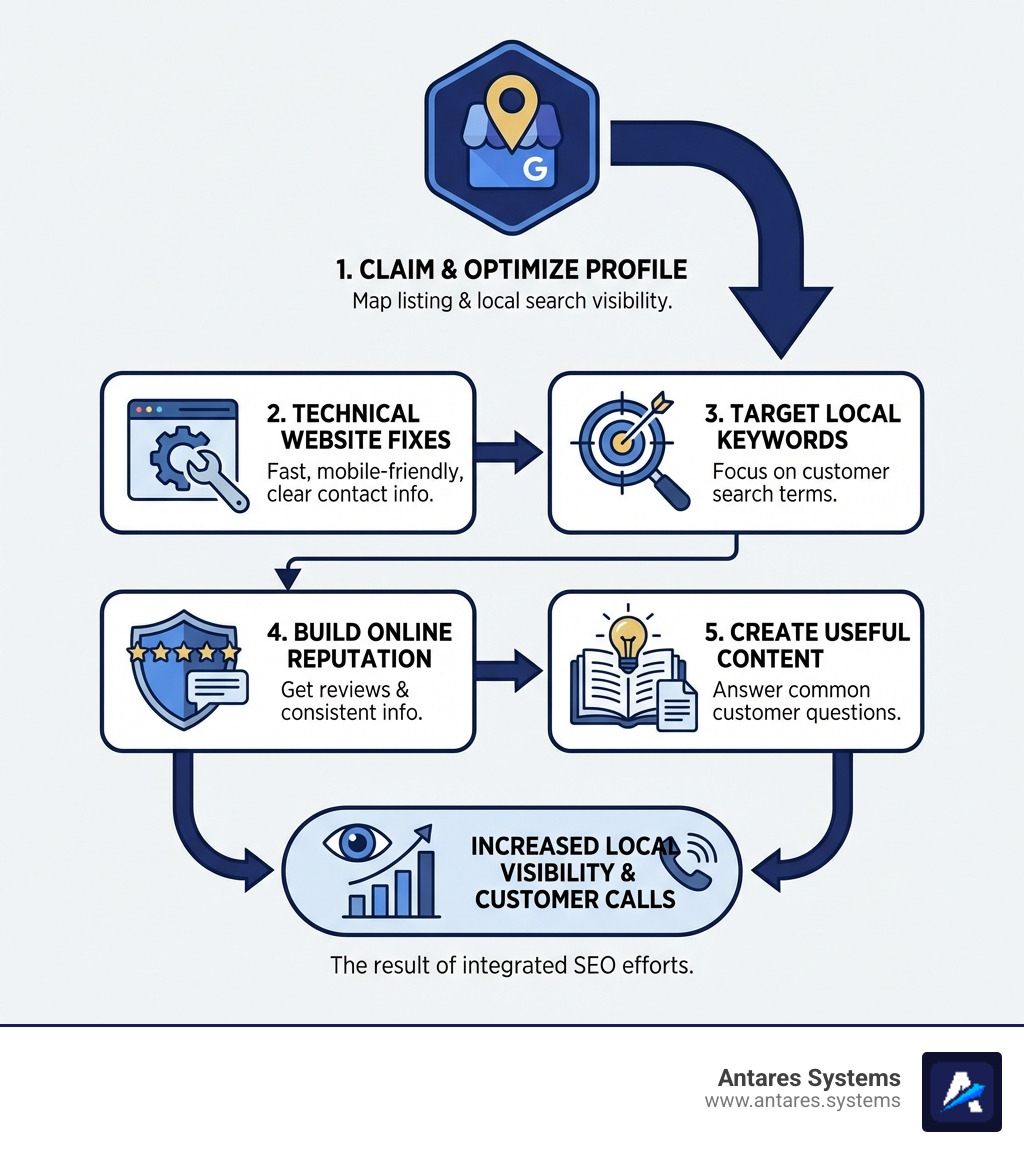
Core SEO Priorities for Small Businesses:
- Claim and optimize your Google Business Profile – Your map listing and the fastest way to appear in local searches.
- Fix basic website issues – Ensure your site is fast, mobile-friendly, and has clear contact info.
- Target the right keywords – Focus on terms customers actually use (for example, "emergency plumber McAllen").
- Build your online reputation – Get reviews and keep your business info consistent online.
- Create useful content – Answer common customer questions on your website to rank for more searches.
With most online experiences starting on search engines and a large share of clicks going to organic results, visibility is key. For local businesses, this is even more critical because so many searches have local intent and often lead to in-person visits.
Unlike paid ads that stop when you stop paying, SEO builds long-term visibility. It takes time—typically several months to see meaningful results—but the investment creates a sustainable source of leads.
I'm Angela D., and I've helped businesses strengthen their online presence through search engine optimization for small businesses, focusing on practical strategies that deliver measurable traffic and lead generation.
What is SEO and Why It's Crucial for Small Businesses
Search Engine Optimization (SEO) is the art and science of getting your website to show up higher in search engine results when people look for your products or services.
Why SEO Matters:
- Visibility is everything: SEO helps your business appear when someone searches for terms like "best BBQ Houston" or "roof repair McAllen." Without it, you're invisible to the vast majority of potential customers who start on a search engine.
- Organic traffic is trusted: While paid ads offer quick visibility, organic traffic is often more trusted and can have a strong conversion rate because users see it as a natural recommendation from the search engine.
- Cost-effective long-term growth: Unlike paid advertising, where visibility disappears the moment you stop paying, SEO builds lasting results. An initial investment in search engine optimization for small businesses creates a sustainable competitive advantage. Organic search accounts for a significant share of online traffic and revenue, proving its direct impact on your bottom line.
- Building trust and credibility: Ranking high on Google signals authority and trustworthiness to potential customers.
- Meeting customer needs: By optimizing your site, you're directly answering the needs of customers at their moment of intent. Generating traffic and leads is a top concern for companies, and many marketers prioritize improving SEO and growing their organic presence.
SEO is about getting found by the right people at the right time to drive sustainable business growth. For more insights, explore our guides on Why Digital Marketing is Important for Small Businesses and Does SEO Work for Small Businesses.
General SEO vs. Local SEO: Knowing Your Audience
For small businesses, especially those with physical locations or service areas, understanding the difference between general and local SEO is fundamental.
General SEO
General SEO aims for broad visibility on a national or global scale. It focuses on ranking for keywords that aren't tied to a specific location, such as "handmade wooden tables" for an e-commerce store that ships nationwide.
Local SEO
Local SEO connects you with customers in your immediate vicinity. It optimizes your online presence to attract people searching for local businesses, using queries like "plumber McAllen TX" or "best pizza Mission."
Key Differences for Small Businesses:
- Geographic focus: General SEO targets a wide audience, while local SEO is narrow and geographically defined.
- Search intent: Local SEO often targets high-intent customers ready to make a purchase.
- Ranking factors:
While they share core principles, local SEO heavily emphasizes:
- Proximity: How close your business is to the searcher.
- Prominence: Your business's reputation, judged by reviews and online listings.
- Relevance: How well your business matches the search query.
For businesses in cities like Austin, Houston, or Pharr, local SEO is critical for showing up when a nearby customer needs your services. To learn more, see our guides on How to do Local SEO for Small Businesses and The Ultimate Guide to Growing Your Business with Local SEO.
Optimizing Your Google Business Profile: Your Digital Storefront
Your Google Business Profile(GBP) is the most important tool for local search engine optimization for small businesses. It's your free digital storefront on Google Search and Maps, and it's often a customer's first impression.
Steps to a Strong Google Business Profile:
- Claim and verify your profile: Claim your business listing on the Google Business page and complete the verification process to confirm ownership.
- Complete every field carefully: Fill out every section with accurate, up-to-date information. Include your business name, address, phone number, website, hours, and a keyword-rich description. Choose the most specific business categories possible.
- Add products, services, photos, and videos: List your offerings and upload quality images of your storefront, work, and team to help your profile stand out.
- Use Google Posts: Announce special offers, events, or updates to keep your profile fresh and engaging.
- Encourage and respond to reviews: Positive reviews are a major ranking factor and trust signal. Encourage satisfied customers to leave reviews and respond to all of them promptly and professionally.
- Maintain NAP consistency: Ensure your Name, Address, and Phone Number (NAP) are identical across your website, social media, and all online directories.
Optimizing your GBP lays a strong foundation for local visibility. Learn more with our Google Business Profile Optimization Services and our guide to Optimize Business Google My Business.
The Power of Online Reviews in Local SEO
Online reviews are the digital equivalent of word-of-mouth recommendations and are critical for a small business's local search rankings and reputation.
Why Reviews Matter:
- Ranking factor: Google considers reviews when ranking businesses in local search.
- Trust and credibility: A business with many positive reviews appears more trustworthy, which is crucial for local services like a roofer in Austin or a painter in Dallas.
- Conversion driver: Positive reviews influence purchasing decisions and can encourage potential customers to choose you over competitors.
- Freshness signal: A steady stream of new reviews signals that your business is active and relevant.
Managing Online Reviews:
- Actively solicit reviews: Politely ask satisfied customers to leave a review on your Google Business Profile or other relevant platforms. Provide direct links to make it easy. See our tips on 4 Ways to Generate Google Reviews and Your Online Reputation.
- Respond to all reviews: Respond thoughtfully to both positive and negative reviews. Thank positive reviewers and address negative feedback professionally to show you value customer experience.
- Monitor multiple platforms: Beyond Google, monitor review sites like Yelp, Facebook, and industry-specific directories.
- Leverage review content: The text within reviews often contains valuable keywords that search engines can use to better understand your business.
Consistently earning and managing reviews boosts your SEO and builds a strong, trusted brand. For more strategies, check out How to Manage Online Customer Reviews: What You Need to Know.
Localizing Your Website for Improved Search Rankings
Beyond your Google Business Profile, your website itself must be optimized for local search to help you rank for "near me" searches and local service queries.
Strategies for Website Localization:
- NAP consistency across your site: Display your Name, Address, and Phone Number (NAP) prominently and consistently on every page, ideally in the footer or header.
- Location-specific content:
- Service area mentions: Clearly state the cities and regions you serve (for example, "We proudly serve homeowners in McAllen, Edinburg, and Mission, Texas").
- City-specific pages:
If you serve multiple areas, create dedicated pages for each (for example,
/plumbing-mcallen-tx/). This allows you to target specific local keywords. Learn more in our guide on Create City Pages for Your Business. - Local blog content: Write posts about local events or community topics, such as "Best Drought-Resistant Plants for Brownsville Gardens."
- Optimized meta tags: Include local keywords in the title tags and meta descriptions of your key pages, such as "Best Bakery in Austin, TX | Fresh Baked Goods & Custom Cakes."
- Structured data (schema markup): Add schema code to your website to help search engines understand your business details like address, hours, and ratings. This can lead to rich snippets in search results. Learn more at schema.org or Google Search Central.
- Local business directories: List your business on relevant local directories like Yelp, Apple Maps, and Bing, ensuring your NAP is consistent everywhere. Our guide on Citation Distribution explains this further.
By weaving local signals throughout your website, you help search engines connect you with nearby customers.
On-Page and Off-Page SEO Factors for Small Businesses
Effective search engine optimization for small businesses requires optimizing elements on your website (on-page SEO) and building authority through external signals (off-page SEO).
On-Page SEO: Optimizing Your Website's Content and Structure
On-page SEO includes all optimizations made directly on your website.
- High-quality website: Your site should be well-designed, easy to steer, and provide a strong user experience. See our Web Design Services.
- Compelling content: Create valuable content that answers customer questions.
- Optimized title tags: Keep under 60 characters and include your primary keyword. Learn more in our Guide to Optimizing Your Title Tags.
- Engaging meta descriptions: Write concise summaries that entice users to click.
- Structured headings: Use H1, H2, H3 tags to organize content with keywords.
- Clean URLs:
Use short, descriptive URLs (e.g.,
yourbusiness.com/services/ac-repair-mcallen). - Image optimization: Compress images and use descriptive alt text.
- Internal linking: Link to relevant pages within your site.
- Mobile-friendliness: A responsive site is essential.
- Site speed: Fast loading times improve rankings and user experience.
For details, see our On-Page SEO Guide.
Off-Page SEO: Building Authority Beyond Your Website
Off-page SEO involves actions taken outside your website to build authority.
- Backlinks: Links from reputable websites act as "votes of confidence."
- Social media engagement: Drives traffic and increases brand visibility. Learn more in How to Boost SEO with Social Media and Secrets Social Media SEO.
- Brand mentions: Mentions on other sites contribute to online prominence.
Keyword Research: Opening up Customer Intent
Keyword research guides your search engine optimization for small businesses strategy by identifying the words and phrases your customers use in search engines.
How to Conduct Effective Keyword Research:
- Understand search intent: Know the "why" behind a search. Is the user looking for information ("how to fix a leaky faucet"), trying to buy ("emergency plumber San Antonio"), or finding a business ("Antares Systems reviews")? Match your content to this search intent.
- Brainstorm seed keywords: Start with broad terms related to your business (for example, "web design," "local SEO").
- Leverage Google suggestions: Use Google's autocomplete and "People also ask" sections to find more specific, long-tail keywords.
- Use keyword tools: Tools like Google Keyword Planner, Semrush, Ahrefs, and AnswerThePublic provide data on search volume, competition, and content ideas.
- Analyze competitors: See what keywords your local competitors are ranking for to find new opportunities.
- Focus on local keywords: Combine your services with location modifiers (for example, "roof repair Houston," "web designer McAllen").
- Avoid keyword stuffing: Write for humans first. Google discourages irrelevant or stuffed keywords. Use keywords naturally.
Systematic keyword research helps your content align with what your audience is actually searching for, driving more qualified traffic. For a deeper dive, read our guide on How to Build a Killer Keyword Strategy.
Benefits of SEO vs. Paid Advertising for Small Businesses
Both SEO and paid advertising (like Google Ads) drive traffic, but they offer different benefits for small businesses.
SEO: The Long-Term Investment
- Sustainable traffic: Once you rank organically, you can attract traffic without ongoing per-click costs.
- Higher trust and credibility: Users often trust organic results more than paid ads, which can lead to stronger engagement.
- Better ROI over time: While SEO takes several months to show significant impact, the long-term return on investment is typically strong.
- Brand building: High rankings build brand recognition and authority over time.
- Competitive advantage: A strong organic presence helps you stand out against competitors with larger ad budgets.
Paid Advertising: The Immediate Boost
- Instant visibility: Paid ads place your business at the top of search results almost immediately.
- Precise targeting: You can target specific demographics, locations, and interests.
- Message control: You have direct control over your ad copy and landing pages.
- Predictable spending: You set a budget and pay per click, allowing for predictable costs.
Putting It Together
For most small businesses, a balanced approach works best. Use paid advertising for immediate leads while investing in SEO for sustainable, long-term growth. Our guides on Do Digital Ads Work in Home Services Marketing and Beginner Guide Small Business Ads can help you decide.
Adapting SEO Strategies in the Age of AI
The rise of Artificial Intelligence (AI) is rapidly changing the search landscape. With AI-powered summaries and answer engines, search engine optimization for small businesses requires adaptation.
How AI is Reshaping SEO:
- Zero-click searches: AI summaries can answer certain queries directly on the search results page.
- Conversational search: Voice search and AI assistants encourage more natural, long-form queries.
- New optimization fields: Generative Engine Optimization (GEO), Answer Engine Optimization (AEO), and Artificial Intelligence Optimization (AIO) focus on making content visible to AI tools.
Strategies for the AI Era:
- Focus on unique, local content: In a world of AI-generated text, human-centric content that leverages your local expertise stands out.
- Use conversational keywords: Target phrases people would actually speak, such as "how do I fix a leaking roof in Houston?" Use tools like Google Trends to identify them.
- Structure content for AI: Use clear headings, bullet points, and FAQs to make it easy for AI systems to extract key information.
- Double down on local SEO: AI often prioritizes local results, so an optimized Google Business Profile and localized website are crucial.
- Showcase E-E-A-T: Demonstrate your Experience, Expertise, Authoritativeness, and Trustworthiness through case studies and customer stories.
- Leverage video and visuals: Optimize content on YouTube, Instagram, and TikTok with descriptive text and captions.
- Monitor AI visibility: Use emerging tools to see if your brand appears in AI-generated answers.
AI emphasizes the need for authentic, high-quality content that serves user intent. Our insights on Local SEO AI Importance and Best AI Tools for Small Businesses provide more context.
Essential Technical SEO Details for a Small Business Website
Technical SEO is the foundation that helps search engines crawl, index, and understand your website.
Key Technical SEO Aspects:
- Crawlability and indexability:
- XML sitemaps: Create and submit an XML sitemap to Google Search Console and Bing Webmaster Tools to help search engines find your important pages.
- Robots.txt: This file tells search engines which pages they should or shouldn't crawl.
- Google Search Console: Use this free tool to monitor indexing status and identify crawl errors.
- Noindex directives: Use a noindex directive to prevent low-value pages from being indexed.
- Site speed:
Fast-loading pages support user experience and rankings. Use Google’s speed tools
to diagnose issues.
- Image compression: Use tools to reduce image file sizes.
- Code optimization: Minimize CSS and JavaScript where possible.
- Hosting: Choose a reliable hosting provider.
- Mobile-friendliness: Your website must be responsive and display properly on all devices, especially smartphones.
- HTTPS (security): Use HTTPS to encrypt data and protect user information. Google favors secure websites.
- Structured data (schema markup): As mentioned earlier, this code helps search engines understand your content and can lead to rich snippets.
- Custom 404 pages: A custom 404 page guides users back to useful content when they land on a broken link.
For a comprehensive review of your site's technical health, consider a Free Internet Business Audit Report or explore our 7-Step Checklist for Your Business Website.
Measuring the Success of Your SEO Efforts
Tracking your SEO progress is crucial for refining your strategy.
Key Tools and Metrics:
- Google Search Console:
This free tool
shows how Google views your site. Track:
- Impressions: How often your pages appear in search
- Clicks: Users who clicked your listings
- Average position: Your ranking for keywords
- Crawl issues and backlinks
- Google Analytics:
This tool
provides user behavior insights. Track:
- Organic traffic: Visitors from search engines
- User behavior: Bounce rate and session duration
- Conversion tracking: Form submissions or phone calls from organic traffic
- Rank tracking tools: Semrush, Ahrefs, or Moz monitor keyword rankings.
- Business metrics:
- Lead generation: Inquiries from organic search
- Sales and revenue: Sales attributed to organic search
- Customer acquisition cost: Cost-effectiveness of SEO vs other channels
Common SEO Challenges for Small Businesses and How to Overcome Them
Search engine optimization for small businesses has unique challenges, but they can be managed with the right strategy.
Challenges and Solutions:
- Lack of expertise:
Many business owners lack deep SEO knowledge.
- Solution: Start with the basics, use free tools like Google Business Profile and Search Console, and consider hiring an expert when you reach your limits.
- Budget constraints:
Professional SEO can be a significant investment.
- Solution: Prioritize high-impact, low-cost strategies like content creation, GBP optimization, and local directory listings.
- Competition with larger brands:
Competing with established businesses can be daunting.
- Solution: Focus on local SEO and target niche, long-tail keywords that larger brands may overlook.
- Time investment:
SEO is a long-term strategy that requires patience.
- Solution: Set realistic expectations. Consistent, incremental effort over time yields the best results.
- Algorithm changes:
Google updates its algorithm frequently.
- Solution: Focus on providing genuine value and a strong user experience. Websites that prioritize helpful, high-quality content tend to be more resilient.
For more on navigating these challenges, our article on SEO for Small Business offers additional perspectives.
When to Consider Hiring an SEO Service or Consultant
While many search engine optimization for small businesses tasks can be handled in-house, professional help can accelerate growth and solve complex issues.
Signs It's Time to Hire an Expert:
- You're not seeing results: If you've applied basic SEO for several months with no improvement, a professional audit can help.
- Complex technical issues: An SEO specialist can diagnose and fix problems with site speed, crawlability, or Core Web Vitals.
- Website redesign or relaunch: An expert can help manage a redesign to protect existing search rankings.
- High competition: In competitive markets, you may need advanced strategies to stand out.
- Lack of time or resources: Outsourcing frees you to focus on your core business.
- Need for advanced strategies: Complex tasks like link building, advanced content strategy, and schema implementation are often best handled by professionals.
- Scaling your business: As you grow, an agency can help scale your SEO efforts effectively.
When choosing an SEO partner, look for transparency, clear reporting, and experience in your industry or local market (for example, Local SEO Services McAllen TX or Houston Web Design for Business).
Foundational Steps for a Small Business to Start with SEO
Ready to begin your SEO journey? Here are the essential first steps for any small business.
- Build a professional website: Your website is your central hub. Ensure it's user-friendly and built on a solid platform. We offer Custom Website Design services for small businesses. See our guide on 6 Key Steps to Building a Great Small Business Website.
- Set up Google Search Console and Google Analytics: These free tools are fundamental for tracking performance. Google Search Console monitors your site in search results, while Google Analytics provides insights into your visitors.
- Optimize your Google Business Profile: This is crucial for local businesses. Claim, verify, and fully optimize your Google Business Profile with accurate information, photos, and services.
- Conduct basic keyword research: Understand what your customers are searching for. Use Google's autocomplete and "People also ask" sections to identify relevant terms.
- Perform initial audits:
- Content audit: Review your existing content. Is it helpful, up-to-date, and answering customer questions?
- Technical audit: Check for basic issues like broken links, slow pages, and mobile-friendliness using free online checkers.
Creating High-Value, Relevant Content for SEO
Content is the fuel for your search engine optimization for small businesses. High-value, relevant content attracts users and signals to search engines that your site is a useful resource.
Strategies for Content Creation:
- Understand search intent: Start with what your audience wants to know. Match your content to their goal, whether it's to learn, buy, or find information.
- Answer customer questions: Turn your most frequently asked questions into blog posts, FAQ pages, or detailed service descriptions.
- Accept E-E-A-T: Google emphasizes Expertise, Experience, Authoritativeness, and Trustworthiness. Demonstrate your knowledge, share real-world case studies, and be transparent and accurate.
- Create original and unique content: Offer fresh perspectives or local angles that set your content apart from competitors.
- Use various content formats:
Engage your audience with a mix of formats:
- Blog posts: Informative articles on industry or local topics. Our guide on Start a Business Blog can help.
- Service pages: Detailed descriptions of your offerings, localized for your service areas.
- FAQs, videos, and infographics: Directly answer questions and use visual content to engage users.
- Refresh and repurpose old content: Update your existing content with new information and insights to keep it fresh. Learn more with this guide on content audits.
- Write for humans first: Prioritize natural language and readability. Engaging content keeps users on your site longer, sending a positive signal to search engines.
Ready to Grow Your Business?
Navigating the complexities of search engine optimization for small businesses can be overwhelming, but you don't have to do it alone. At Antares Systems, we specialize in crafting custom SEO strategies that drive real results for local businesses across the Rio Grande Valley, McAllen, Edinburg, Mission, Pharr, Brownsville, Austin, San Antonio, Houston, Dallas, and Miami.
Whether you need to boost your local rankings, optimize your website, or develop a comprehensive digital marketing plan, we've got you covered.
Explore Our Services:
- Local SEO Services
- Web Design Services
- Reputation Management
- Google Business Profile Optimization Services
- Digital Marketing for Home Builders
- Digital Marketing Home Services
- Digital Marketing for Lawyers
- McAllen Website Design
- Local SEO Services McAllen TX
- Houston Website Design
- Local SEO Services Houston TX
- Dallas Website Design
- Mission Website Design
- Pharr Website Design
- Austin Website Design
- San Antonio Website Design
- Brownsville Website Design
Visit our website to schedule a consultation and see how we can help you turn more searches into customers.