Position Yourself for Success: A Guide to SEO Positioning
Why Search Engine Positioning Matters for Your Business
Search engine positioning SEO is the focused practice of optimizing specific web pages on your site to rank higher in search results for targeted keywords—driving more qualified traffic, leads, and customers to your business.
Quick Answer: What is Search Engine Positioning?
- Definition: A subset of SEO that focuses on improving the rank of individual pages for specific keywords, rather than optimizing your entire website
- Primary Goal: Move pages from positions 4-20 into the top 3 results where 54.4% of all clicks happen
- Key Difference from General SEO: Targets specific high-value pages (service pages, product pages) instead of sitewide improvements
- Timeline: Can show results in days or weeks, versus 4-12 months for broader SEO campaigns
- Best For: Businesses with pages already ranking on page 2 or lower page 1 that need a targeted push
You've spent time and money building your website. You've created pages for your services. You've written content. But when potential customers in McAllen or Brownsville search for what you offer, your competitors show up first—and you're nowhere to be found.
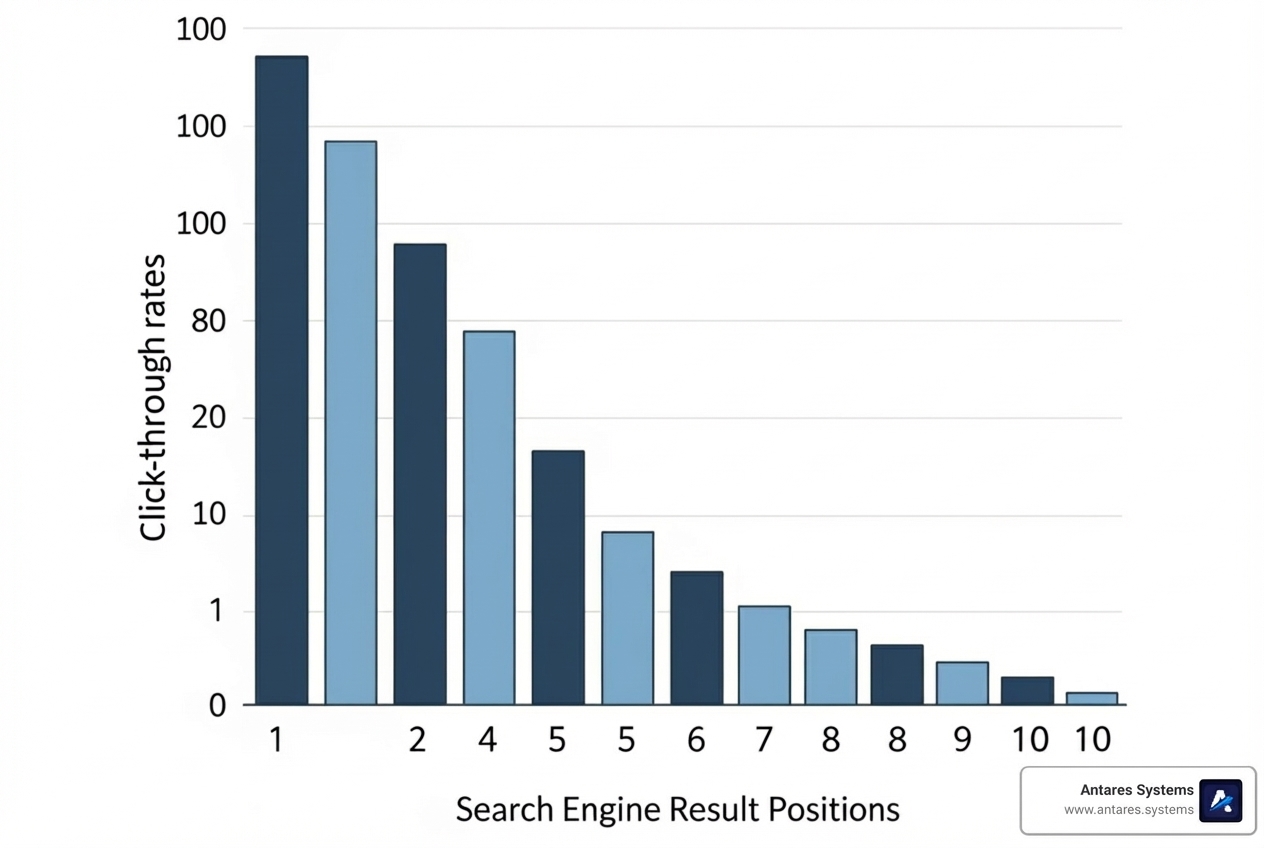
Here's the reality: the top three Google results capture more than half of all clicks. The tenth result? Just 2.4%. Moving up even one position can boost your click-through rate by 30%.
This is where search engine positioning becomes critical. Unlike broad SEO strategies that try to improve your entire website over many months, positioning focuses on specific pages that are close to ranking well—and pushes them into those top spots where customers actually click.
For service businesses in the Rio Grande Valley, this targeted approach means faster results. Instead of waiting six months to see traffic, you can often move a page from position 8 to position 3 in weeks by refreshing content, optimizing internal links, and improving user signals.
I'm Angela D., an SEO Account Manager with a strong technical background who has helped businesses achieve double-digit organic traffic growth through targeted search engine positioning SEO strategies. Over the years, I've seen how focusing on the right pages—rather than everything at once—delivers measurable results faster for businesses that need leads now, not eventually.
What Exactly is Search Engine Positioning?
At its core, search engine positioning SEO is a highly strategic and concentrated effort within the broader field of Search Engine Optimization (SEO). While general SEO aims to improve the overall visibility and health of your entire website, positioning zeroes in on individual web pages with the explicit goal of pushing them to the very top of search engine results pages (SERPs) for specific, high-value keywords.
Think of it this way: Google is the dominant search engine, holding a global market share of almost 82% in desktop search, and even higher in mobile. If your target customers in Houston or Dallas are searching for your services, you absolutely need to be visible on Google.
Search engine positioning isn't just about getting on the first page; it's about dominating it. It's the continuous practice of optimizing specific web pages to achieve higher—and more numerous—results in search engines for those keywords that directly lead to sales or leads. This might involve aiming for the top organic link, but also securing featured snippets, appearing in "People Also Ask" boxes, or even ranking multiple pieces of content (like a blog post and a video) for the same search term. We're maximizing what we call "SERP real estate."
The goal is to make a specific page so compelling and relevant that it becomes the "last click" a user needs. This means providing such comprehensive and satisfying information or solutions that they don't need to return to the search results to look for alternatives.
For a deeper dive into the fundamentals of SEO, you can explore our guide: Que es SEO: Maximizando Visibilidad Online.
Search Engine Positioning vs. General SEO: Understanding the Nuance
While closely related, it's crucial to understand how search engine positioning SEO differs from a general, holistic SEO strategy. They are complementary, but serve different tactical purposes.
Search Engine Positioning
- Main Focus: Optimizing a handful of specific, high-value pages (e.g., service pages, product pages, key landing pages) that are ready to rank higher.
- Timeline for Results: Often delivers faster results, sometimes within days or weeks, especially for pages already on the second page of Google. This is because we're refining existing potential, not building from scratch.
- Scope: Tactical, concentrated effort on specific keywords and pages. It's about making a few stars shine brightest.
- Goal: To dominate specific SERP features (like featured snippets) and secure top 1-3 organic rankings for targeted, often commercial, keywords.
- Investment: Typically requires a more focused, sometimes intensive, effort on fewer pages.
General SEO
- Main Focus: Improving the overall authority, relevance, and technical health of your entire website. This includes site architecture, broad keyword research, and ensuring all pages are crawlable and indexed.
- Timeline for Results: A long-term strategy. It can take between three to six months to see optimal results across your entire website, and often four months to a year for significant sitewide impact.
- Scope: Holistic, broad-spectrum approach covering technical SEO, content strategy, link building, and user experience across the entire domain. It's about building a strong foundation and a healthy ecosystem.
- Goal: To increase overall organic traffic, build brand authority, improve user experience across the site, and adapt to Google algorithm updates.
- Investment: An ongoing, sustained investment across various aspects of your website.
The key takeaway is that search engine positioning SEO can yield results within a few days for specific pages, making it an attractive strategy for businesses in Austin or San Antonio looking for quicker wins, provided a solid SEO foundation is already in place.
For a broader understanding of digital marketing strategies, including the differences between SEO and SEM, check out our article: Diferencia entre SEO y SEM.
Why Search Engine Positioning is a Game-Changer for Businesses
For any business, especially those serving local communities in the Rio Grande Valley, Edinburg, or Mission, appearing prominently in search results isn't just nice to have—it's essential. Search engine positioning SEO is not just about vanity metrics; it directly impacts your bottom line.
Here's why it's a game-changer:
- Increased Visibility & Organic Traffic: We know that the top three Google results capture a whopping 54.4% of all clicks. The first result alone gets about 27.6% of all clicks, while the tenth result languishes with just 2.4%. By pushing your key pages into these top spots, we dramatically increase the likelihood that potential customers will see and click on your website. This means more organic traffic, which translates directly to more leads and sales.
- Competitive Advantage: In competitive markets like Dallas or Miami, every edge counts. If your competitors are stuck on page two, and your optimized pages are consistently ranking in the top three, you're capturing the lion's share of attention. This positions your business as the go-to authority in your niche.
- Improved Brand Recognition & Trust: When your brand name consistently pops up first in relevant searches, it tells searchers that your brand is trustworthy and authoritative. This builds invaluable brand recognition and customer loyalty over time. People tend to trust what Google puts at the top.
- Higher Conversion Rates: Traffic driven by search engine positioning SEO is often highly targeted. When someone searches for "best plumber Houston TX" and lands on your perfectly optimized plumbing service page, they're already looking for what you offer. This leads to higher conversion rates compared to broader, less intent-driven traffic.
- Maximizing SERP Real Estate with Featured Snippets & AI Overviews: Beyond the traditional blue links, Google's SERPs are rich with features like featured snippets, "People Also Ask" boxes, and video results. Improving your search engine positioning SEO increases the likelihood of your page getting selected for these prominent features, effectively giving you more visibility and more clicks without even occupying the #1 organic spot.
By focusing on search engine positioning SEO, we help businesses not just exist online, but thrive, by connecting them with customers actively searching for their services. For more on the importance of digital presence, read our articles: Why Digital Marketing is Important for Small Businesses and SEO for Small Business.
Strategies for Improving Your Search Engine Positioning
Now that we understand the immense value of search engine positioning SEO, let's dig into the actionable strategies we employ to get your key pages ranking higher.
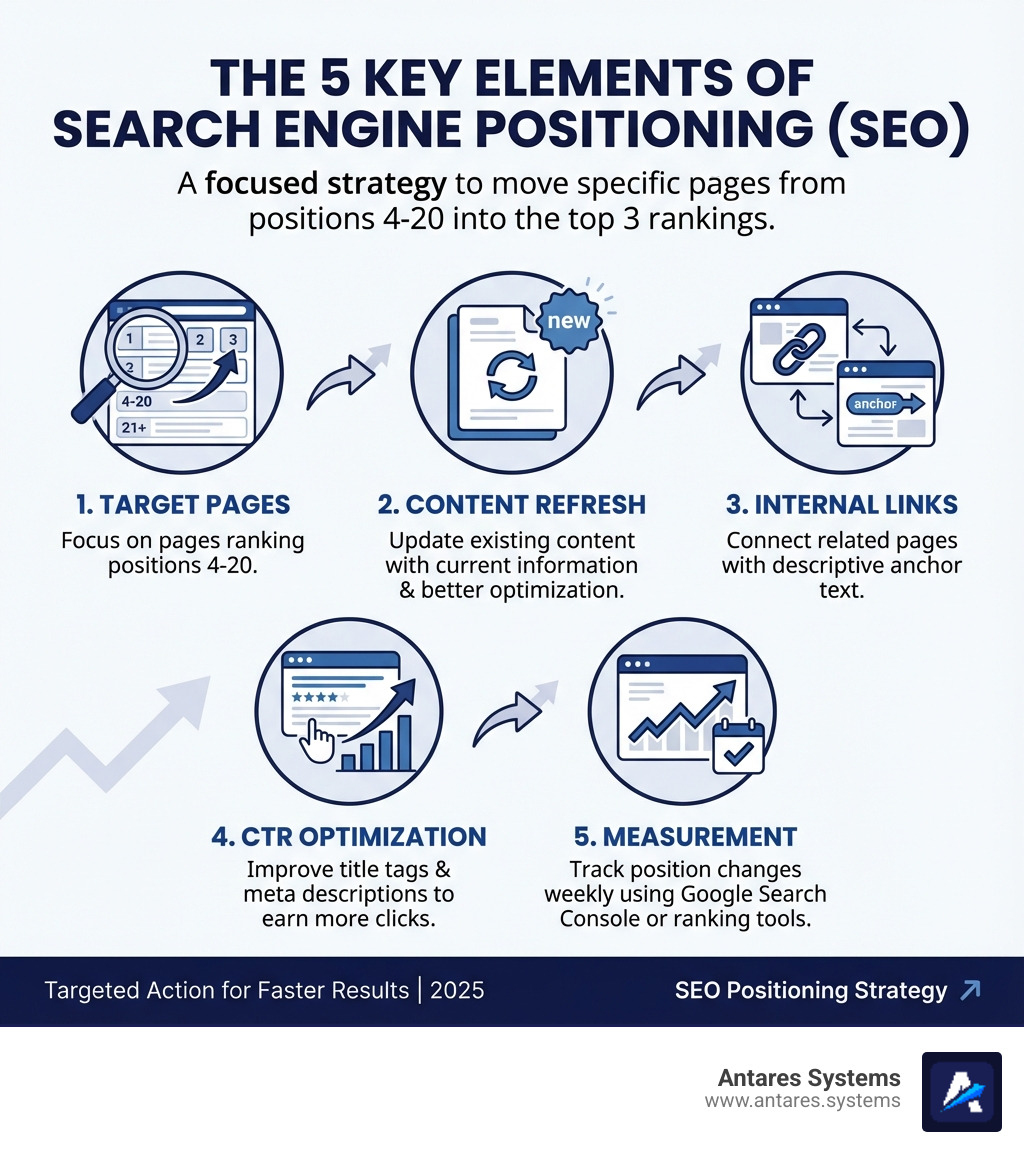
Identify Your Target Pages: Where to Focus Your Efforts
The first, and arguably most crucial, step in search engine positioning SEO is identifying which pages to focus on. We don't want to waste effort on pages that are too far from ranking or have low commercial intent.
We look for pages that are:
- On the Cusp: Pages ranking on the second page of Google (positions 11-20) or lower on the first page (positions 4-10). These pages already have some authority and relevance; they just need a targeted push. We can identify these using tools like Google Search Console's Performance report, which shows average position for your keywords.
- High Commercial Intent: These are typically your service pages, product pages, or lead magnet pages. For a home services company in McAllen, this would be your "HVAC Repair McAllen" page or "Emergency Plumber Brownsville" page. These pages directly lead to conversions.
- Evergreen Content: Content that remains relevant over time, continually attracting traffic.
We use Google Search Console to analyze your website's performance. By logging in and navigating to the "Performance" report, we can see which pages are getting clicks and impressions, and their average position. This allows us to pinpoint opportunities for improvement.
For businesses targeting specific neighborhoods or cities, identifying the right pages also means understanding local search intent. Our guides on How to Do Local SEO for Small Businesses and Target Local Keywords to Increase Your Business Visibility provide valuable insights.
Content is King: Refresh, Optimize, and Create Value
Content plays an undeniable and central role in search engine positioning SEO. Google's primary goal is to provide the most helpful and relevant answer to a user's query. Our content must be superior to what's already ranking.
- Refresh Existing Content: Instead of always creating new content, we often achieve significant gains by refreshing existing pages. This involves:
- Updating Outdated Information: Ensuring all facts, statistics, and external links are current. Google prefers fresh content, and older pages can lose ranking if not updated.
- Improving Readability: Using clear language, shorter paragraphs, subheadings (H2, H3, H4), bullet points, and visual elements like images or videos.
- Expanding Completeness: Ensuring the content thoroughly answers all potential user questions related to the topic. The goal is to be the "last click"—the definitive resource that fully satisfies the user's intent, so they don't need to go back to the SERP.
- Optimizing for New Keywords: As search trends evolve, we might integrate new, relevant keywords and synonyms that have emerged since the page was first published.
- Match Search Intent: Before we even write or refresh, we carefully analyze the search intent behind a keyword. Is the user looking for information, a commercial product, a specific location, or to complete a transaction? For example, if someone searches for "best AC repair San Antonio," they're likely looking for a local service provider, not just general information about AC repair. Our content must align with this intent.
- Create Superior Value: Google provides clues and guidelines on how they evaluate content, emphasizing utility, trust, authority, and user experience. We aim to create content that is unique, helpful, reliable, and "people-first." As we often say, content without value is spam, and if we want to rank, we must provide superior value.
To create compelling and effective content, we also focus on optimizing your title tags and developing a strong keyword strategy. Check out our guides: The Ultimate Guide to Optimizing Your Title Tags and How to Build a Killer Keyword Strategy.

On-Page Optimization: Mastering the Basics for Positioning
On-page optimization involves fine-tuning elements directly on your web pages to signal relevance and quality to search engines. For search engine positioning SEO, these details are critical.
- Title Tags: Your title tag is the clickable headline in the SERP. We optimize it to be unique, clear, concise (under 60 characters for optimal display), and keyword-rich. It should accurately describe the page's content and entice users to click.
- Meta Descriptions: While not a direct ranking factor, a compelling meta description (around 105 characters) acts as an advertisement for your page. It should summarize the page's content, include target keywords, and feature a strong call-to-action to improve organic click-through rate (CTR). Google's Rich Snippet Gallery offers examples of how good descriptions can stand out.
- Headers (H1, H2, H3): We use headers to structure your content logically, making it easy for both users and search engines to understand. Your H1 should contain your primary keyword, with H2s and H3s breaking down subtopics and integrating secondary keywords naturally.
- Keyword Integration: We strategically place your target keywords and their synonyms throughout the page—in the body text, image alt text, and even the URL. However, this must be done naturally, writing for the reader first, to avoid "keyword stuffing," which Google penalizes.
- URL Structure: We ensure your URLs are descriptive, concise, and include your primary keyword. For example,
yourbusiness.com/services/ac-repair-mcallenis much better than a string of random characters. - Schema Markup: This structured data helps search engines better understand the content on your page, making it eligible for rich snippets (like star ratings, FAQs, or pricing) directly in the SERPs. Studies have demonstrated that schema can help you to rank
and improve visibility. We implement relevant schema types like
ArticleorLocal Businessfor your key pages.
For a comprehensive checklist on optimizing your website, refer to our guide: 7-Step Checklist for Your Business Website: How to Optimize Your Site.
The Power of Links: Internal and External
Links are the highways of the internet, guiding both users and search engine crawlers. Their strategic use is fundamental to effective search engine positioning SEO.
- Internal Linking: This refers to links within your own website, connecting one page to another. Internal links are vital for:
- Crawlability: They help search engine crawlers find all your site's pages.
- Link Equity Distribution: They pass "ranking power" (link equity) from stronger pages to weaker ones, giving them a boost.
- User Navigation: They improve user experience by making it easy for visitors to find related content.
- Anchor Text: The clickable text of an internal link signals to search engines what the linked page is about. We use natural, varied, and descriptive anchor text (e.g., "learn more about HVAC services in Houston" instead of just "click here"). Google's General Webmaster Guidelines advise limiting the number of links on a page to a reasonable number (a few thousand at most) to avoid diluting link equity.
- External Linking (Backlinks): These are links from other websites pointing to your page. Backlinks are a powerful signal of authority and trust to search engines.
- Quality Over Quantity: Not all backlinks are created equal. A few high-quality, relevant links from authoritative websites (like local news sites, industry partners, or reputable directories in McAllen or San Antonio) are far more valuable than many low-quality links.
- Link Building: We employ strategies to earn these valuable backlinks, such as creating highly shareable content, engaging in local community partnerships, and strategic outreach. Building links is a core component of improving your search engine positioning SEO.
For a deeper dive into how to build a strong link profile, explore our guide: How to Implement a Local Backlink Strategy for Your Business.
Technical SEO: The Foundation for High Rankings
Even with brilliant content and a robust link profile, poor technical SEO can hinder your search engine positioning SEO efforts. Technical elements ensure Google can properly crawl, index, and understand your pages.
- Core Web Vitals: These are a set of web standards that measure user experience, including page loading speed, interactivity, and visual stability. While not a direct ranking signal, improving Core Web Vitals significantly improves user experience, which indirectly impacts SEO by reducing bounce rates and increasing dwell time. Google measures these based on real-world user data.
- Mobile-Friendliness: With the majority of searches happening on mobile devices, your pages must be responsive and provide an excellent experience on smartphones and tablets.
- HTTPS: Ensuring your website uses HTTPS (a secure connection) is a basic security measure and a minor ranking factor.
- Crawlability & Indexability: Google's crawlers need to be able to access and understand your page's content, including resources like CSS and JavaScript. We use tools like the URL Inspection Tool in Search Console to check how Google sees your page and ensure there are no technical impediments.
Understanding and optimizing these technical aspects is crucial. Our article Google Core Web Vitals Basics provides more detail.
Measuring Your Search Engine Positioning Success
In search engine positioning SEO, measurement is key. We need to know if our efforts are paying off and where to adjust. Fortunately, Google provides powerful free tools for this.
- Google Search Console: This is our go-to tool. We use the "Performance" report within Search Console to track:
- Average Position: This shows the average ranking of your page for specific keywords. We look for improvements in this metric for our target pages.
- Clicks & Impressions: These tell us how often your page appears in search results and how often users click on it.
- Click-Through Rate (CTR): A higher CTR indicates that your title and meta description are compelling and relevant to users. Moving up just one spot can improve CTR by 30%.
- Rank Tracking Tools: For more granular tracking and competitive analysis, we use dedicated rank tracking tools. These allow us to monitor the daily or weekly position changes for our target keywords, compare performance against competitors, and identify opportunities for further optimization.
- Traffic & Conversion Monitoring: The goal of search engine positioning SEO is to drive business growth. We monitor organic traffic to your target pages and, most importantly, track conversion rates (e.g., form submissions, phone calls, sales). This helps us understand the real-world impact of our positioning efforts.
Regularly reviewing these metrics allows us to make informed decisions, iterate on our strategies, and ensure your pages continue to climb the ranks. For a detailed approach to evaluating your local SEO health, consult our guide: How to Perform a Local SEO Audit for Your Business.
Potential Drawbacks and Challenges of Search Engine Positioning
While incredibly effective, search engine positioning SEO isn't without its challenges. It's important to approach it with realistic expectations.
- Requires Foundational SEO: Search engine positioning SEO works best when your website already has a solid SEO foundation. If your site has severe technical issues, a weak overall domain authority, or very little existing content, a broader SEO strategy will likely be needed first. It's tough to get a single page to rank if your entire site is struggling.
- Competitive Landscape: Some keywords, especially in high-value industries in busy cities like Dallas or Miami, are highly competitive. For instance, ranking for "most popular sneakers" is incredibly difficult due to the sheer volume and authority of major retailers. While search engine positioning SEO can help, it requires sustained and superior effort in such environments.
- Algorithm Updates: Google's algorithms are constantly evolving. What works today might need adjustment tomorrow. Staying informed and adaptable is crucial. Pages that rank well today might drop after a major update, requiring us to re-evaluate and re-optimize.
- Continuous Effort: Search engine positioning SEO is not a "set it and forget it" strategy. Competitors are always optimizing, and user search behavior changes. Continuous monitoring, refreshing content, and adapting to new opportunities are essential to maintain top positions.
- Not a Substitute for Holistic SEO: While effective for specific pages, search engine positioning SEO doesn't replace the need for a holistic, long-term SEO strategy for your entire website. Overall site health, broad keyword coverage, and consistent content creation are still vital for sustained growth.
Despite these challenges, the focused nature of search engine positioning SEO often makes it a more manageable and faster path to tangible results for businesses looking to boost specific services or products. For more general SEO tips and insights for 2024, check out our Consejos SEO para Posicionar Web en Google 2024.
Conclusion: Position Your Business for Best Online Growth
In today's hyper-competitive digital landscape, simply having a website isn't enough. Your business needs to be found, and critically, it needs to be found at the top of search results where customers are actively looking. Search engine positioning SEO offers a powerful, targeted approach to achieve precisely that.
By carefully identifying high-value pages, optimizing content for search intent and completeness, finessing on-page elements, leveraging the power of internal and external links, and ensuring a robust technical foundation, we can propel your key web pages into those coveted top-three spots. This isn't just about rankings; it's about driving tangible business outcomes: more organic traffic, more qualified leads, and ultimately, more growth for your business in the Rio Grande Valley, Houston, Austin, or wherever you serve.
At Antares Systems, we specialize in helping businesses like yours achieve unparalleled online visibility. Our AI-powered marketing solutions and expert team understand the nuances of search engine positioning SEO and are dedicated to crafting strategies that deliver measurable results. Don't let your competitors capture all the clicks. Let us help you position your business for best online success.
Ready to dominate the search results and see your business thrive?
- Find how our Local SEO Services can put your business on the map.
- Explore our comprehensive Web Design Services to build a high-performing online presence.
- Learn about our Google Business Profile Optimization Services to improve your local search visibility.